Some cities pay electrical engineers more than software developers
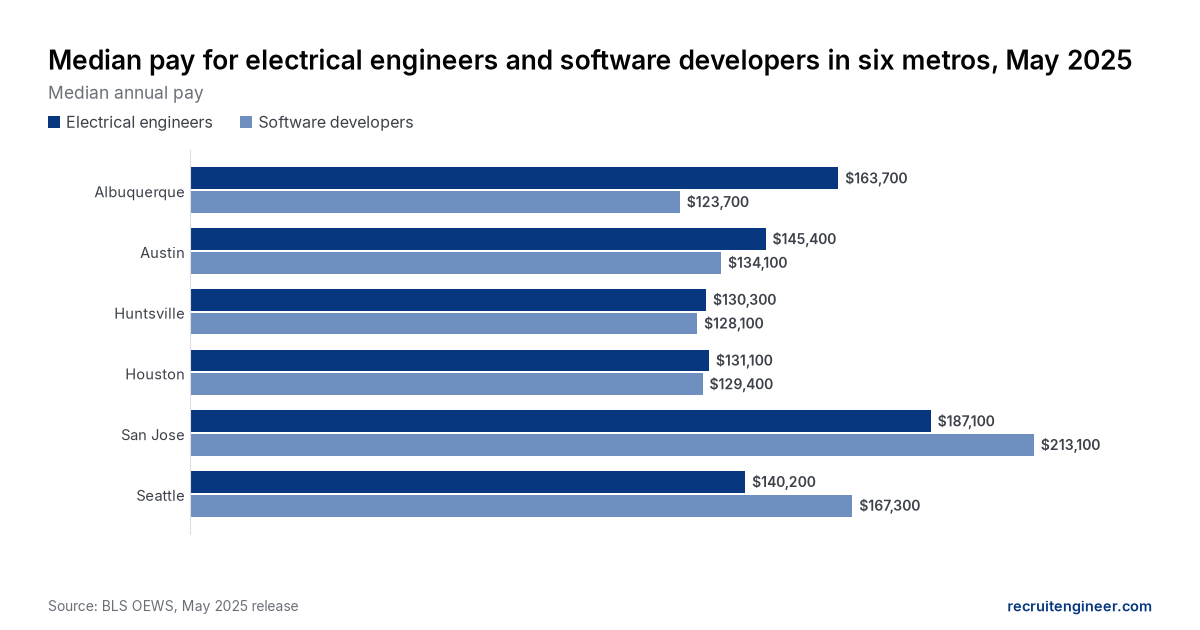
The Austin metro has about 32,000 software developers. It also pays its electrical engineers more than it pays those developers, which is a slightly odd thing for a software town to do, because you might expect a crowd that large to set the going rate for anyone who writes code.
In Seattle and San Jose software developers earn far more than electrical engineers. But Albuquerque, Austin, Huntsville and Houston all pay the typical electrical engineer at least as much as the typical software developer. If you hire firmware and embedded engineers, people who could plausibly have come up through either job, those four metros are worth thinking about a little differently.
Six metros and two pay lines
Federal wage data for May 2025 from the Bureau of Labor Statistics gives separate pay figures for software developers and electrical engineers in metros across the country. The median is the typical worker, the one standing in the middle when everybody in the job is sorted by pay.
| Metro | Electrical engineers, median pay | Software developers, median pay | Gap at the median | Electrical engineers employed | Software developers employed |
|---|---|---|---|---|---|
| Albuquerque, NM | $163,700 | $123,700 | $40,000 to electrical | 1,280 | 2,280 |
| Austin-Round Rock-San Marcos, TX | $145,400 | $134,100 | $11,300 to electrical | 4,070 | 31,960 |
| Huntsville, AL | $130,300 | $128,100 | $2,200 to electrical | 2,190 | 7,030 |
| Houston-Pasadena-The Woodlands, TX | $131,100 | $129,400 | $1,700 to electrical | 5,770 | 22,940 |
| San Jose-Sunnyvale-Santa Clara, CA | $187,100 | $213,100 | $26,000 to software | 4,160 | 87,350 |
| Seattle-Tacoma-Bellevue, WA | $140,200 | $167,300 | $27,100 to software | 4,930 | 92,770 |
In Huntsville and Houston the gap is small enough that you would call the two jobs priced the same, which is itself a little surprising given how many more software developers those metros have. Albuquerque is the other extreme. There the typical electrical engineer earns $40,000 more than the typical software developer, in a metro where neither group is very big.
Why a firmware search should care
Firmware is, roughly, the software that lives on a chip and tells a piece of hardware what to do. A good candidate for that work might have started as a software developer and learned to read a schematic. Or they might have started as an electrical engineer and learned to write code that fits in very little memory.
So when you make that person an offer, what you are competing with is their next best job. And their next best job is whichever of the two occupations pays more where they live, because a person who can do both can take either. In Seattle that means software pay. A firmware engineer there who gets an offer pegged to electrical engineering pay can go write software for someone else and earn more, so in Seattle you benchmark against software.
In Albuquerque it runs the other way. If you price an embedded role off software developer pay because the job title has the word software in it, you are offering a software developer’s wage to someone whose other option is an electrical engineering job that pays a lot more. That offer will tend to get turned down by the candidates who know the hardware best, who are the ones you were hoping to hire.
The rule is short enough to fit on an index card. Find both medians for the metro and price the role against the higher one. The awkward part is that the higher one changes from city to city. A company that pegs embedded pay to software everywhere will be too cheap in Albuquerque, while one that pegs it to electrical engineering everywhere will be too cheap in Seattle.
The gap gets bigger as you go up
The median is only the middle of the market. If you are hiring someone senior, the better comparison is the 75th percentile, the point where three quarters of workers in the job earn less. For a junior hire the matching figure is the 25th percentile.
| Metro | Percentile | Electrical engineers | Software developers | Gap |
|---|---|---|---|---|
| Albuquerque, NM | 25th | $131,700 | $99,800 | $31,900 to electrical |
| Albuquerque, NM | 75th | $202,700 | $159,800 | $42,900 to electrical |
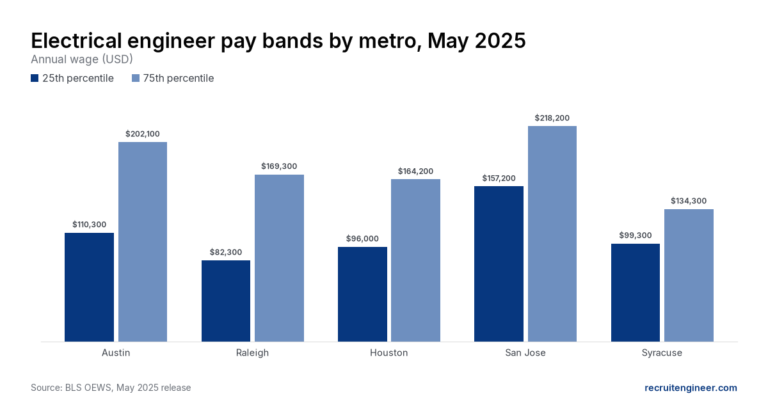
| Austin-Round Rock-San Marcos, TX | 25th | $110,300 | $104,000 | $6,300 to electrical |
| Austin-Round Rock-San Marcos, TX | 75th | $202,100 | $168,700 | $33,400 to electrical |
Austin is the one worth staring at. At the junior end the two jobs pay about the same, with a gap of $6,300. At the senior end it opens to $33,400, which means a senior embedded engineer in Austin with an electrical background has a much better outside option than the medians suggest. If you set a senior firmware offer in Austin off the software developer median, you would be wrong twice, once for using the wrong occupation and once for using the middle of the market when you wanted the top of it.
Say you have two finalists for a senior firmware role in Austin, one who spent years as a software developer and one who spent years as an electrical engineer. Each of them is weighing your offer against what people like them earn near the top of their own job. If you make them the same offer, it will look generous to the first one and thin to the second, which is a strange result for two people who would be doing the same work.
Albuquerque does not need the percentile argument, because electrical engineers come out ahead at every level shown. If you are hiring embedded engineers there, you are bidding in the same metro as Sandia National Laboratories and Intel. So price the role off electrical engineering pay and treat software developer pay as the floor.
Huntsville and Houston are close calls
In Huntsville and Houston the two medians sit within a few thousand dollars of each other. That makes the benchmark question mostly academic at the median, which is convenient, because you can use either number and be roughly right. It also means your candidate pool is effectively bigger than either occupation alone.
Houston has about 23,000 software developers and about 5,800 electrical engineers. If your embedded role can be filled from either group, you get to recruit from both at about the same price. That is the opposite of Seattle, where a firmware candidate with a software background has a big pay reason to stay in software. If you get to choose where an embedded team sits, a metro where the two jobs pay the same is one where you are not bidding against either of them.
What to do next
If you are hiring embedded engineers in one of these metros, pull both occupations before you write the offer, then the percentile that matches the level you want. The engineering salary guide puts the pay figures for different engineering jobs in one place. The metro pages go a step further, for example electrical engineering recruiting in Albuquerque or software engineering recruiting in Austin.
If you could run only one search, Austin is where you might start, because it has by far the deepest software pool of the four metros where electrical pay wins and a senior electrical pay level that tells you where your offer needs to land. A search that draws from both pools can start with either the electrical engineering practice or the software engineering practice, as long as the offer is priced off the higher of the two.