
You could hire aerospace engineers in Huntsville instead of Seattle
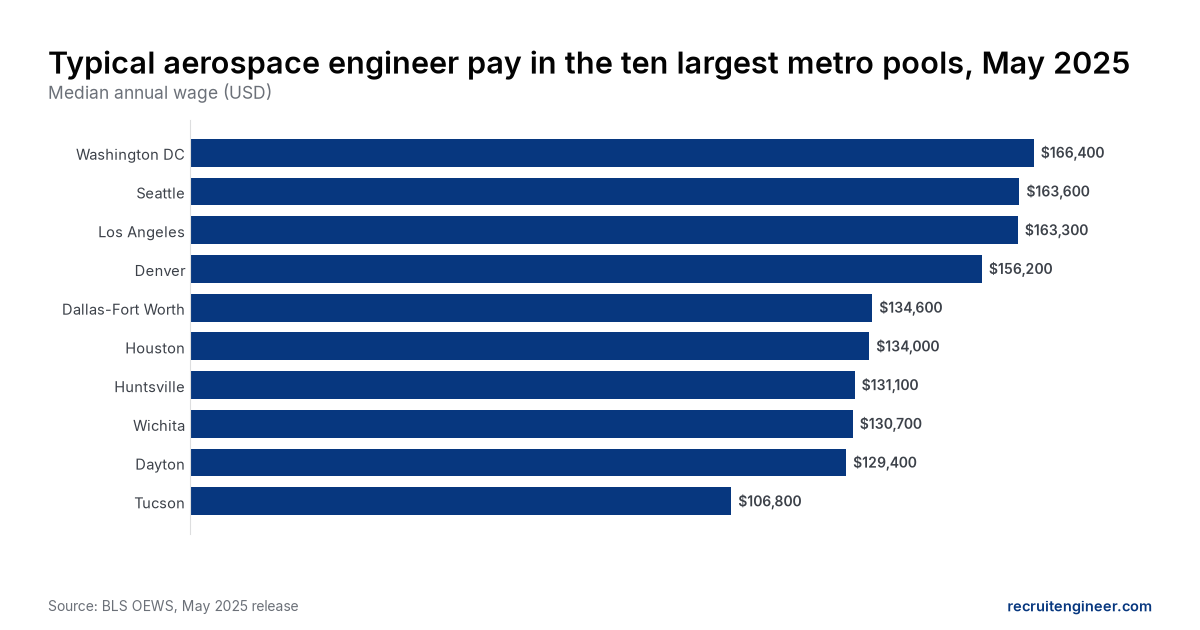
If you need aerospace engineers, the obvious place to look is Seattle or Los Angeles, because that is where the aerospace engineers are. This works, but it is expensive: the typical one in Seattle earns $163,600. Huntsville, Alabama has almost as many, and the typical one there earns $131,100. So you might at least try Huntsville first.
Where the aerospace engineers are
If you rank metros by how many aerospace engineers they employ, using federal wage data for May 2025, the top ten look like this. The ranking only covers metros that report a count. Atlanta’s count is withheld in the federal data, so it might belong somewhere on this list and simply cannot be placed.
| Metro | Aerospace engineers employed | Typical (median) annual wage |
|---|---|---|
| Seattle-Tacoma-Bellevue, WA | 5,480 | $163,600 |
| Los Angeles-Long Beach-Anaheim, CA | 5,200 | $163,300 |
| Huntsville, AL | 4,880 | $131,100 |
| Dallas-Fort Worth-Arlington, TX | 3,430 | $134,600 |
| Washington-Arlington-Alexandria, DC-VA-MD-WV | 2,420 | $166,400 |
| Denver-Aurora-Centennial, CO | 2,010 | $156,200 |
| Houston-Pasadena-The Woodlands, TX | 1,890 | $134,000 |
| Tucson, AZ | 1,720 | $106,800 |
| Wichita, KS | 1,430 | $130,700 |
| Dayton-Kettering-Beavercreek, OH | 1,400 | $129,400 |
Read down the wage column and the list splits into two groups. Seattle, Los Angeles, Washington and Denver all pay something like Seattle money. Washington in fact pays $2,800 more than Seattle at the median, which is worth knowing if your plan was to save money by moving the team east.
The second group is Huntsville, Dallas-Fort Worth, Houston, Wichita and Dayton. Their typical wages sit within $5,200 of each other and roughly a fifth below Seattle. Add up those five pools and you get about 13,000 aerospace engineers, which is more than the roughly 10,700 that Seattle and Los Angeles hold between them. So the cheaper tier is not a handful of people scattered around the country. It is the bigger market, more or less, and it just happens to be spread across more cities.
Texas makes the point neatly. Dallas-Fort Worth and Houston together hold about 5,300 aerospace engineers, which is a little more than Los Angeles. If you were willing to run one search across both metros, taking in aerospace engineers in Houston as well as Dallas, you would be fishing in a pool about the size of Los Angeles while paying something closer to Huntsville prices.
Tucson is the outlier. It has a sizable pool and a typical wage $56,800 below Seattle’s, which is a much bigger gap than anywhere else on the list. The federal numbers do not say why, so it is worth finding out what the jobs there actually involve before you treat the Tucson aerospace market as a bargain.
You could just hire in Huntsville
The simplest version of the idea is to stop recruiting in Seattle and recruit in Huntsville instead. The pool there is only 600 engineers smaller while the typical engineer costs $32,500 less a year. Hire ten of them and that is $325,000 a year of salary you did not spend, which is real money even in an industry that builds rockets.
The work is there too. Lockheed Martin and Northrop Grumman both appear among the missile and space employers in the Huntsville area. Wichita works the same way on a smaller scale, with aerospace manufacturers that include Boeing Wichita and Textron Aviation. A typical aerospace engineer in Wichita costs $32,900 less than one in Seattle.
There is one obvious objection. If Huntsville is cheap, the employers in Huntsville presumably know that, because they are the ones paying those wages. The local median is not a discount they have failed to notice. It is simply the price in that market, so you get it by joining that market and competing with those employers for the same people at the same rates. This is a perfectly good deal, as long as you do not expect it to feel like one when the candidates are also talking to the companies down the road.
The discount is mostly in the middle
A median describes the typical engineer, but you may not be hiring the typical engineer. The 75th percentile is the pay level that only a quarter of engineers earn more than, which is a fair stand-in for an experienced hire. The 25th percentile is the same idea from the bottom.
| Metro | 25th percentile | Median | 75th percentile |
|---|---|---|---|
| Seattle-Tacoma-Bellevue, WA | $131,900 | $163,600 | $181,500 |
| Dallas-Fort Worth-Arlington, TX | $107,700 | $134,600 | $177,500 |
| Huntsville, AL | $100,100 | $131,100 | $167,100 |
| Wichita, KS | $100,800 | $130,700 | $166,900 |
At the median, Huntsville sits $32,500 below Seattle. At the 75th percentile the gap narrows to $14,400 for Huntsville and $14,600 for Wichita. Dallas-Fort Worth is the extreme case, because its typical engineer costs $29,000 less than Seattle’s but its top quarter starts only $4,000 below Seattle’s.
So the cheaper metros are cheaper mostly for engineers in the middle of the range. A quarter of Seattle’s aerospace engineers earn less than $131,900, which is about what the typical one in Huntsville earns. Meanwhile an experienced lead in Dallas-Fort Worth will probably cost you close to Seattle rates, so you might as well put that in the budget now instead of finding out at the offer stage.
Moving a Seattle engineer to Wichita
Say you have found an engineer in Seattle who earns right at the Seattle median and you would like them to do the job from Wichita. The first offer that comes to mind is the Wichita market rate. To you that is a fair local salary. To the engineer it is a $32,900 pay cut. They will probably compare it with what they earn now rather than with the median of a city they have not moved to yet. That offer will not work.
The second offer matches their Seattle pay. In Wichita that salary lands just under the local 75th percentile of $166,900, so you are paying a mid-career Seattle engineer like a senior Wichita one. This is a reasonable thing to do if they are worth it, though it costs money every year and the people you hired locally at the median may eventually compare notes.
The third approach is to move someone senior instead. At the 75th percentile the gap between Seattle and Wichita is $14,600, less than half the gap at the median, so a relocation package plus a modest step down in pay starts to look like something a person could accept. Or you skip the move altogether and hire in Wichita at Wichita rates, which was sort of the point of looking at Wichita in the first place.
Where to start
If you are filling several mid-level roles, start with aerospace hiring in Huntsville and the Wichita aerospace market, where the typical wage is far below Seattle’s and the pools are big enough to staff a team. For one senior hire, the savings outside Seattle are smaller than the medians suggest. In that case it is worth comparing aerospace engineers in Dallas with a relocation offer to Seattle talent, since the top of the Dallas-Fort Worth range is already close to Seattle pay.
You can run the same kind of comparison for other metros with the engineering hiring value tool. If you would rather hand the whole search to someone else, you can start with aerospace engineering recruiting and take it from there.


