Chemical engineers are in five places and your plant is probably in a sixth
Do you need a relocation budget to hire a chemical engineer? Probably yes, unless your plant happens to sit in one of five metro areas, because chemical engineers are bunched up in a few places.
Say you run a plant outside Cincinnati and you need a process engineer who can explain a mass balance and then go fix the column it describes. Federal wage data counts about 300 chemical engineers in the whole Cincinnati metro. That is a count of people employed as chemical engineers. Every one of them already has a job and a few of them may already work for you. The number who could do your job and would also leave theirs this quarter is some modest slice of that, so you might reasonably hope for a handful of serious candidates. You could wait for the handful to turn into one. Or you could pay to move someone from a place that has more of them.
Where the large pools are
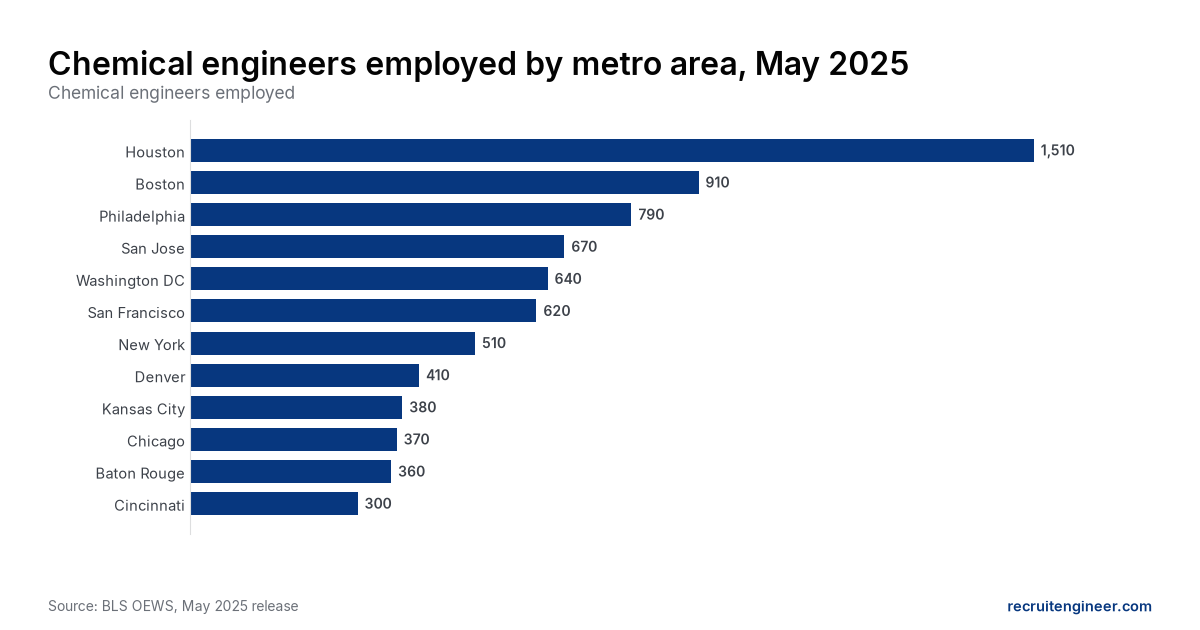
Among the metro areas where the federal data publishes both a headcount and a typical salary for chemical engineers, only five count more than 500 of them. Houston is the largest by a distance, with about 1,500. Boston, Philadelphia and Washington DC follow, with New York just clearing the bar. The counts and pay come from the federal Occupational Employment and Wage Statistics tables for May 2025.
| Metro area | Chemical engineers employed | 25th percentile pay | Median pay | 75th percentile pay |
|---|---|---|---|---|
| Houston-Pasadena-The Woodlands, TX | 1,510 | $126,300 | $138,100 | $178,700 |
| Boston-Cambridge-Newton, MA-NH | 910 | $79,100 | $109,500 | $144,000 |
| Philadelphia-Camden-Wilmington, PA-NJ-DE-MD | 790 | $97,700 | $127,800 | $161,600 |
| Washington-Arlington-Alexandria, DC-VA-MD-WV | 640 | $97,800 | $132,800 | $162,300 |
| New York-Newark-Jersey City, NY-NJ | 510 | $95,500 | $126,800 | $149,200 |
| San Jose-Sunnyvale-Santa Clara, CA | 670 | Withheld | Withheld | Withheld |
| San Francisco-Oakland-Fremont, CA | 620 | Withheld | Withheld | Withheld |
Two Bay Area metros belong in that list on headcount alone. San Jose has about 670 chemical engineers and San Francisco about 620, but the government withholds their pay figures for this occupation. So you know the engineers exist without knowing what they cost, which makes them hard to budget for.
Houston is the big pool and the pricey one
The largest pool is also the best paid of the five, and the second largest is the cheapest. The typical Houston chemical engineer earns $138,100 while the typical Boston one earns $109,500, a gap of $28,600. The data does not explain the gap and you do not really need it to.
What you need is to know which pool your offer can actually reach. An employer paying around the Boston median is making a perfectly competitive offer in Boston and a weak one in Houston, even though it is the same offer for the same job. Relocation money covers the move. It does not cover the difference between what a candidate earns now and what you pay, so the pool you recruit from decides the salary more than the pool you hire into.
Gulf Coast plants have Houston next door
If your plant is in Baton Rouge, Beaumont or Lake Charles, you already have a local pool in the low hundreds and Houston is the closest large pool. Pay along that stretch already looks a lot like Houston pay. The typical Baton Rouge chemical engineer earns $134,800, which is $3,300 below the Houston median. Lake Charles sits closer still.
| Metro area | Region | Chemical engineers employed | Median pay |
|---|---|---|---|
| Denver-Aurora-Centennial, CO | Mountain West | 410 | $128,100 |
| Kansas City, MO-KS | Midwest | 380 | $102,300 |
| Chicago-Naperville-Elgin, IL-IN | Midwest | 370 | $110,800 |
| Baton Rouge, LA | Gulf Coast | 360 | $134,800 |
| Cincinnati, OH-KY-IN | Midwest | 300 | $107,600 |
| Beaumont-Port Arthur, TX | Gulf Coast | 140 | $129,900 |
| Lake Charles, LA | Gulf Coast | 100 | $136,800 |
So on the Gulf Coast the relocation is the cheap kind. You are recruiting from a pool that already earns roughly what you pay, which means the move is the main expense instead of a raise stacked on top of it. Houston is the first market you might work for a plant anywhere along that coast, and chemical engineering hiring in Houston is the useful comparison for pay. A plant in Lake Charles can also fish in its own smaller pond first, since its median is already Houston-sized.
The Midwest is a flight from everywhere
Midwest plants have it harder. Chicago, Kansas City and Cincinnati each have a few hundred chemical engineers, which is respectable, but none of them is next door to one of the five large pools. The typical engineer in all three also earns less than the typical engineer in Houston, Philadelphia, Washington or New York.
That second part is the expensive one. The typical Houston chemical engineer earns $27,300 more than the typical Chicago one. Moving that person to Chicago means paying for the move and then paying for a raise they did not need to ask for. The alternative is asking them to take a pay cut for the privilege of relocating, which is an awkward thing to write into an offer letter.
Boston is the useful exception. It is the second largest of the five pools and its typical chemical engineer earns $1,900 more than the typical one in Cincinnati. So for a Midwest plant, Boston is the large pool where an offer near your local median might not read as a pay cut. Philadelphia is the next one to try, though its median sits closer to Houston than to yours. Among metros that report a headcount, Denver has the largest second-tier pool and a median $300 above Philadelphia, which is worth knowing if your plant is anywhere in the Mountain West.
Put the move in the requisition
All of which suggests a fairly dull plan. If your plant is outside the five large metros, put a relocation line in the budget when you open the role instead of adding it after the local search comes up short. A relocation package written in week one reads as part of a real job. One improvised in week ten reads as a concession.
Then decide which pool you are fishing in and price the offer to that pool, not to your own metro. A Gulf Coast plant fishes in Houston and should expect Houston pay. A Midwest plant might fish in Boston first, where its offer lands near the local median. Philadelphia can come second, but only with an offer priced to Philadelphia pay instead of your own. If the role needs someone senior, price it against the 75th percentile of the source pool instead of the median. Hoping to pull a Houston engineer at Midwest pay is hoping for someone who wants to move for reasons other than money, which is a fine thing to hope for and a hard thing to plan around.
A candidate who is being asked to move also wants to know exactly what the job is. Spell out the process, the feedstocks and the operating conditions in the posting so that an engineer three states away can tell whether the work is worth packing for.
For a Midwest search the next step is to compare chemical engineering pay in Philadelphia with what a local hire in Cincinnati or Chicago would cost. The engineering hiring value tool puts metros side by side for that comparison. If you want help running a search that crosses state lines, start with chemical engineering recruiting.