Robotics recruitment strategies: split the job into hardware, controls and integration
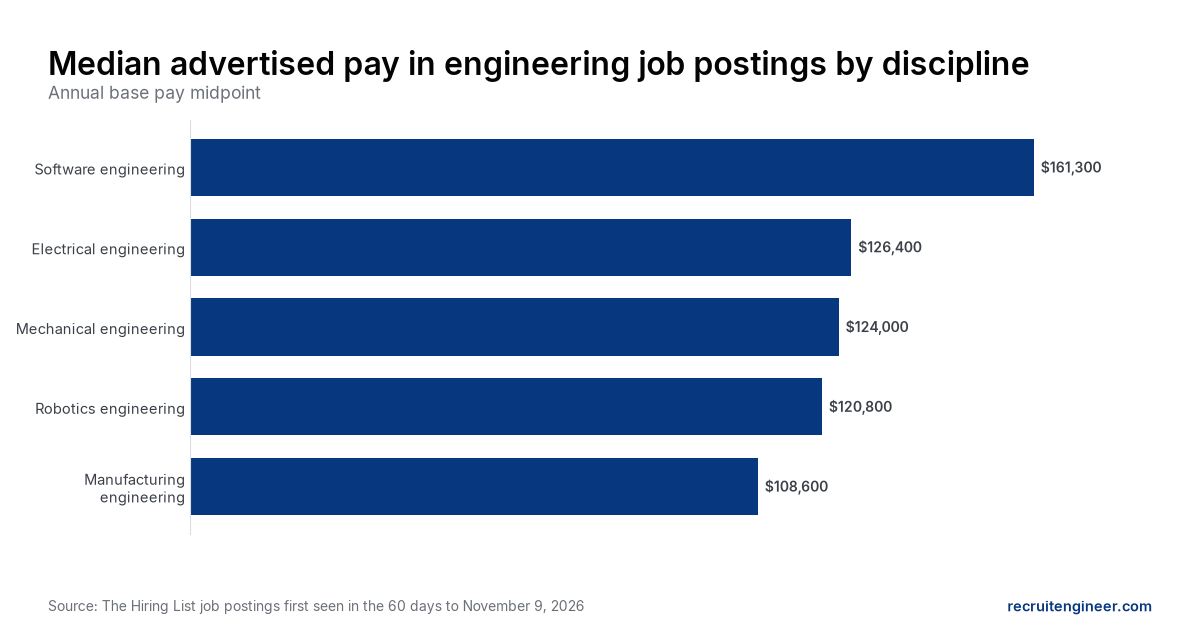
A job posting for a robotics engineer typically advertises a little less pay than one for a plain mechanical engineer. That is strange, because robots are supposed to be the expensive and futuristic corner of engineering. Mechanical engineering sounds like the thing you study before you specialize in robots, so you would expect the specialized version to cost more than its parent.
Our analysis of 196 robotics engineering job postings that listed pay, collected by The Hiring List and first seen in the 60 days to November 9, 2026, puts the typical posting’s midpoint at $120,800. Mechanical engineering postings from the same window came in at $124,000, which is $3,200 higher.
One reasonable way to read that is that robotics engineer is less a job than a label. A plant that needs someone to keep a welding cell running can post a robotics engineer opening. So can a startup that needs someone to make a robot recognize a box on a shelf. The median blends those together. Any sensible set of robotics recruitment strategies starts with working out which robotics engineer you actually mean.
The title covers four different jobs
Say you run a plant and you want a robot to load parts into a machine. You need somebody to design the gripper, somebody to write the logic that tells the robot and the machine when to move and somebody to stand on the floor at two in the morning when it drops a part. A startup building a robot that drives around a warehouse also needs somebody to make it see. All four of those people can fairly call themselves robotics engineers. They have different training and different pay expectations. They would answer different job postings if the postings said which one was wanted.
| Specialty | What the work is | Where candidates come from | A screening task that shows real robot time |
|---|---|---|---|
| Mechanical and hardware design | Arms, grippers, end effectors, frames and drive trains, sized for loads, stiffness and wear | Mechanical engineering and mechatronics programs, equipment makers | Bring a part they designed for a robot and explain how it failed or how it would fail |
| Controls and PLC | Motion control, PLC logic, safety circuits and the handshake between the robot controller and the rest of the line | Controls integration firms, plant controls groups, mechatronics programs | Read a short PLC program with a planted bug and find why the robot never gets its start signal |
| Perception and software | Cameras, sensors, motion planning and the code that decides what the robot does next | Software and computer science programs, university robotics labs, robot product companies | Given the log of a failed pick, say what the robot believed and why it was wrong |
| Field integration | Installing, commissioning and debugging robot cells at a plant or customer site | Integrators, automotive and other plants that run robot cells, robot makers’ service teams | Walk through the last cell they commissioned and what broke on the first day of production |
Work out which one the job needs
The useful question is what fails first if nobody in the building can do it. If you bought a robot cell from an integrator and it keeps faulting, you need a controls engineer. A perception specialist would be bored there, which is a costly way to be bored.
If you are designing the robot itself, the first hire is probably hardware or software depending on which part you are not buying off the shelf. If you are an integrator selling cells to other companies, the person you most need is the one who commissions them at customer sites, because that is the work your customers pay for. Sometimes the answer really is two of the four. Then you have two jobs to fill and you might as well admit it in the postings.
Where each kind of candidate comes from
Mechatronics and robotics degree programs are the plainest place to look for junior hardware and controls people. In Detroit the University of Detroit Mercy College of Engineering and Science offers robotics programs next to mechanical and electrical engineering, which makes it a reasonable first stop if your robots sit near the car industry. The same region is home to General Motors and Ford Motor Company as well as Stellantis, so plant engineers who have kept robot cells running are close by. If that is your market, the page on robotics engineers in Detroit covers who hires there.
Plant experience matters more than it sounds. OSHA notes that robots are generally used for unsafe, hazardous and highly repetitive tasks, so the people who maintain them have spent years on the unglamorous failures. A candidate from a controls integration firm has a different kind of depth, because building cells for many customers means seeing many robots and many ways to wire them wrong.
Perception and software candidates look much more like software engineers who happen to like hardware. Robot product companies are one source. Boston Dynamics in Waltham builds legged and warehouse robots, and the market for robotics engineers in Boston is the one to study if this is the hire you need. These people also compare your offer against ordinary software engineering jobs, which matters for pay.
What robotics postings advertise
The figures are midpoints of the annual base pay ranges in each posting, from the same Hiring List postings first seen in the 60 days to November 9, 2026. They are grouped by the discipline and level of the posting.
| Postings | Count | 25th percentile | Median | 75th percentile |
|---|---|---|---|---|
| Robotics engineering, all levels | 196 | $102,800 | $120,800 | $150,000 |
| Robotics engineering, mid level | 110 | $97,500 | $120,000 | $145,500 |
| Robotics engineering, senior | 77 | $119,100 | $138,100 | $168,800 |
| Mechanical engineering, all levels | 5,737 | $100,000 | $124,000 | $149,200 |
| Mechanical engineering, senior | 2,616 | $122,700 | $142,400 | $162,500 |
| Electrical engineering, all levels | 8,285 | $105,000 | $126,400 | $152,000 |
| Manufacturing engineering, all levels | 3,615 | $90,000 | $108,600 | $129,500 |
| Software engineering, all levels | 7,942 | $129,700 | $161,300 | $200,000 |
| Software engineering, senior | 4,861 | $149,000 | $178,300 | $212,500 |
Robotics postings sit close to mechanical and electrical ones at every point, well above manufacturing and well below software. That is what you would expect if many of them describe hardware and controls work at plants. It also means the robotics median is a poor guide for the perception hire.
Take a senior perception engineer. The robotics figure says $138,100 at the median. The software postings that person is also reading say $178,300. The difference is $40,200 at the median, and it is roughly the gap a robotics-priced offer has to explain to that candidate. For a controls or integration hire, the robotics and electrical engineering rows are the fairer anchors.
Too few of the robotics postings were entry level to give a figure for new graduates. If you want one, you are probably competing with mechanical and electrical postings for the same people, which is one more reason to title the job by what it does.
Screening for someone who has actually run a robot
Robot experience is easy to claim from a lab course or a simulation. The useful screens ask about the moments when real robots go wrong, and OSHA says many robot accidents happen during non-routine conditions such as programming, maintenance, testing, setup or adjustment. Those are exactly the hours a hands-on candidate has lived through.
- Ask what they do before stepping inside a robot’s working envelope to teach a point, and listen for specific steps rather than a general promise to be careful.
- Ask which robot controller and teach pendant they used most and what they found annoying about it, because people who have used one for months tend to have an opinion.
- Ask an integration candidate which safety standard their last cell was built to and how they checked it.
- Ask a hardware candidate for the payload and reach of a robot they designed tooling for, and why the first gripper design changed.
- Ask a software candidate how their code behaved when a sensor returned garbage in the middle of a move.
For the safety question it helps to know the vocabulary yourself. OSHA lists ANSI/RIA R15.06 as the US national adoption of ISO 10218 for industrial robots and says these consensus standards are not OSHA regulations. An integrator who has done the work will talk about them without being prompted. A candidate who has only programmed robots in simulation probably will not, which is fine for some jobs and a problem for others.
Write one posting per specialty
The posting that asks for gripper design, PLC programming, machine vision and half-time travel to customer sites describes four people. Each qualified candidate reads it and sees mostly things they do not do, so the people who apply anyway are the ones who read it less carefully. It also forces one pay range onto jobs that sit in different markets, which means the range is too low for the software person and possibly too high for the rest.
So write the specialty down first, choose the pay row that matches it and write the screening task before the posting goes up. If you need two specialties, post two jobs. The robotics engineering practice is where to start if you would rather have help sorting which of the four you are hiring.