The highest-paying engineering jobs, ranked by May 2025 pay
Which engineering job pays the most? Computer hardware engineering does, among jobs you can start with a bachelor’s degree: the typical computer hardware engineer earned $161,700 in May 2025, according to the federal profile of computer hardware engineers. After that the highest-paying engineering jobs bunch together, and the order matters a bit less than a ranking suggests.
Typical here means the median, the engineer in the exact middle of the field with half earning more and half earning less. It is a good number for ranking jobs because a few huge salaries at the top cannot drag it around. It is a worse number for predicting your own pay, which depends on who employs you and where you live. Later it also depends on whether you are still doing engineering at all.
The ranking, by typical pay
The Bureau of Labor Statistics keeps a career handbook. Its architecture and engineering chapter lists median pay for May 2025 next to the usual entry-level education, which is a bachelor’s degree for every engineer occupation in it. The chapter lumps electrical and electronics engineers together. Their electrical and electronics engineers profile splits them, which is how they appear in the ranking.
| Rank | Occupation | Median pay, May 2025 |
|---|---|---|
| 1 | Computer hardware engineers | $161,700 |
| 2 | Petroleum engineers | $144,900 |
| 3 | Aerospace engineers | $135,000 |
| 4 | Nuclear engineers | $134,000 |
| 5 | Electronics engineers, except computer | $130,200 |
| 6 | Chemical engineers | $125,000 |
| 7 | Electrical engineers | $120,600 |
| 8 | Health and safety engineers | $115,200 |
| 9 | Materials engineers | $112,900 |
| 10 | Marine engineers and naval architects | $112,200 |
| 11 | Bioengineers and biomedical engineers | $109,400 |
| 12 | Environmental engineers | $107,100 |
| 13 | Mining and geological engineers | $106,200 |
| 14 | Mechanical engineers | $104,100 |
| 15 | Industrial engineers | $102,400 |
| 16 | Civil engineers | $100,800 |
| 17 | Agricultural engineers | $98,600 |
From top to bottom the list spans $63,100, which is a fairly narrow band for a group that holds computer hardware engineers at one end and civil and agricultural engineers at the other. You could read the order as a rough list of how expensive the thing you design is when it goes wrong. Chips, oil wells, aircraft and reactors all sit near the top. The people who design them are paid accordingly.
Who pays you matters about as much as the field
A median for a whole occupation blends together everybody who does the job, and they do not all work for the same kind of employer. Petroleum engineers are the cleanest example. In oil and gas extraction the typical one earned $180,100, while at engineering services firms the typical one earned $96,000, according to the federal profile of petroleum engineers. That is $84,100 apart for, more or less, the same degree.
One way to see it is from the employer’s side. The company that owns the oil is, roughly, paying for decisions about its own wells, while a services firm is paying for hours it bills to a client. Computer hardware shows a milder version of this, with research and development employers at $171,800 and the federal government at $137,000. So if you are comparing two offers in the same field, the industry line may matter more than the job title.
What it takes to get into each one
Every job in the ranking starts from a bachelor’s degree. For petroleum, aerospace, nuclear, chemical and electrical engineering the handbook also says a license is not required at entry level, so the professional engineer license is something you might add later rather than a gate at the start. The differences are in the details.
| Field | Degree the handbook describes | Other things that matter |
|---|---|---|
| Computer hardware engineers | Computer engineering or a related field such as electrical engineering | Some employers require or prefer a master’s in computer engineering |
| Petroleum engineers | Petroleum engineering or a related field such as mechanical, civil or chemical engineering | Internships and cooperative education programs give practical experience that employers value |
| Aerospace engineers | Aerospace engineering or a related field | Defense projects may need a security clearance and some levels require US citizenship |
| Nuclear engineers | Nuclear engineering or a related engineering field | Some research and development jobs need a master’s or a PhD |
| Electronics and electrical engineers | A related engineering field | A license is not required at entry level |
| Chemical engineers | Usually a four-year program, with some five-year programs awarding a bachelor’s and a master’s | Some employers prefer internship or co-op experience |
Read across and the ranking is mostly decided by a choice you make at 18, which is a lot of weight to put on an 18-year-old. But the doors are not equally wide. Petroleum is the most forgiving to switch into on paper, because the handbook names mechanical, civil and chemical degrees as related fields. Aerospace has a gate a degree cannot open, since some clearance levels require US citizenship. Computer hardware tilts the other way, with some employers wanting a master’s.
The size of each field matters too. The handbook counts about 18,500 petroleum engineering jobs and about 16,600 nuclear ones. Computer hardware has about 76,100 while electrical and electronics engineers together hold about 297,900. A high median in a small field is a high median for fewer people.
Petroleum also has a modest outlook in the handbook, which projects employment to grow 2 percent from 2025 to 2035. It expects about 1,000 openings a year, mostly to replace people who leave. If you pick petroleum for the pay, you might want a degree that also works somewhere else.
The best-paid engineering job is managing engineers
Step one rung outside the engineering chapter and the top spot changes hands. Architectural and engineering managers earned a typical $171,300 in May 2025, according to the federal profile of architectural and engineering managers. That beats every engineer occupation in the ranking. The handbook says the job usually asks for five years or more of related work experience on top of the degree.
This is a slightly funny feature of the profession, which pays its engineers most once they are mostly deciding what other engineers should work on. It is also a sensible one. If a manager’s decisions shape a whole team’s output, paying them more than any single engineer on that team is a reasonable bet. So the surest route to the top of an engineering pay ranking may run through the middle of whichever field you already like.
Where the 75th percentile sits
The median tells you where the middle of a field sits. The 75th percentile is the pay that only a quarter of the field beats, which makes it a fair target for an engineer who is good at the job and has been doing it a while.
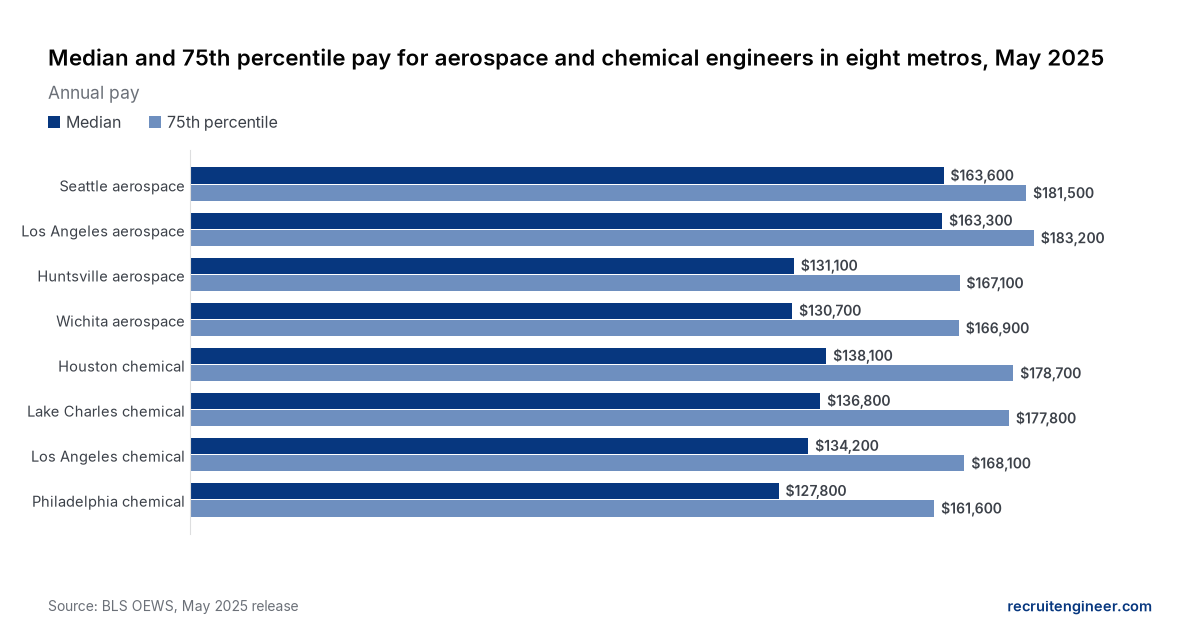
Federal wage data for May 2025 gives both figures by metro area in the BLS Occupational Employment and Wage Statistics tables. Here they are for aerospace and chemical engineering in four metros each.
| Field | Metro | Jobs | Median | 75th percentile |
|---|---|---|---|---|
| Aerospace | Seattle | 5,480 | $163,600 | $181,500 |
| Aerospace | Los Angeles | 5,200 | $163,300 | $183,200 |
| Aerospace | Huntsville, AL | 4,880 | $131,100 | $167,100 |
| Aerospace | Wichita, KS | 1,430 | $130,700 | $166,900 |
| Chemical | Houston | 1,510 | $138,100 | $178,700 |
| Chemical | Lake Charles, LA | 100 | $136,800 | $177,800 |
| Chemical | Los Angeles | 320 | $134,200 | $168,100 |
| Chemical | Philadelphia | 790 | $127,800 | $161,600 |
Huntsville’s typical aerospace engineer earns $32,500 less than Seattle’s. At the 75th percentile the difference is $14,400. So the distance between the two cities is mostly a distance in the middle, and an experienced engineer near the top in Huntsville is paid a lot more like Seattle than the median suggests. If you are weighing a Huntsville aerospace offer, compare it with the 75th percentile there rather than the median. If you are hiring aerospace engineers there, that is probably the number your experienced candidates have in mind.
Chemical engineering pays best of these four on the Gulf Coast. Houston and Lake Charles beat Los Angeles and Philadelphia at both the median and the 75th percentile, though Lake Charles counts only about 100 chemical engineers, so one plant’s hiring plans could move the whole local market.
What to do with the ranking
If you are picking a major, electrical or computer engineering looks like the best value on this ranking. The computer hardware profile names both as routes in, and electrical and electronics engineers fill two more of the top seven places in a far larger job pool than petroleum or nuclear.
If you are already working, retraining is the expensive move. The cheaper ones are a switch to a better-paying kind of employer in your own field or a move to a metro where the 75th percentile is high. The petroleum figures suggest the first can be worth a lot. For other disciplines the engineering salary guide is the next place to look.
If you are hiring in one of the top fields, set offers for experienced people from the local 75th percentile rather than the median, and we can help with aerospace engineering or chemical engineering searches.