How to write an engineering job description engineers will read to the end
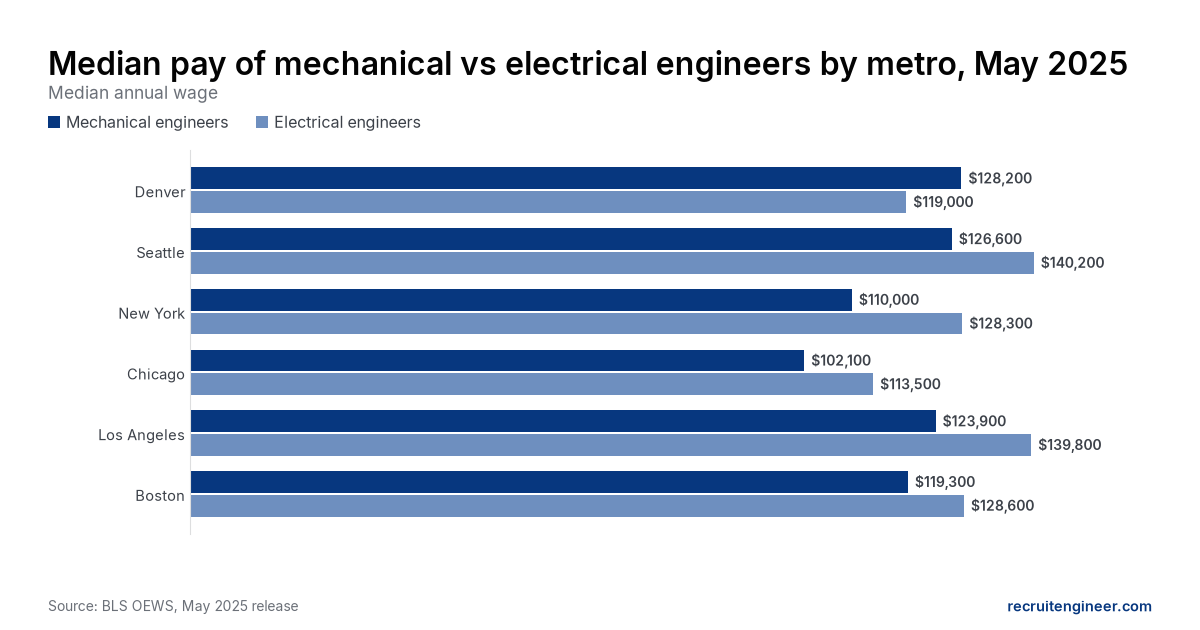
In Denver, the typical mechanical engineer earns more than the typical electrical engineer. In Seattle, New York, Chicago, Los Angeles and Boston it runs the other way. In Seattle the gap is $13,600 in the electrical engineer’s favor. This is odd because you might expect the pecking order of engineering disciplines to be a fixed fact, like the boiling point of water. It is a local fact instead.
That matters for an engineering job description in a fairly specific way. If you write the electrical posting by copying the mechanical one and changing the title, the pay range comes out too high in Denver and too low in the other five. So a job description is less a piece of marketing than a small document of facts. An engineer reads it roughly the way they read a spec sheet, looking for the numbers and the constraints while skipping the adjectives.
What an engineer is reading for
Think about what an engineer is doing when they open your posting. They are trying to answer a narrow question, which is what they would spend a Tuesday afternoon working on and whether they would be good at it. Every line either helps answer that or sits in the way. So you might put the lines that answer it first and see how much of the rest survives.
The actual problem
Say what the team is building or fixing, in the words you would use with another engineer. “Design and develop mechanical systems” could describe almost any mechanical job. “Redesign the cooling on an enclosure that runs hot at full load” describes one job, and an engineer who has done that work will recognize it in a sentence. If the project is confidential, say the category and the stage instead: a new product still in prototyping or a plant expansion waiting on permits.
Tools, codes and standards
Name the software and the standards. A mechanical engineer who sees SolidWorks or Creo in the first lines learns more from those two words than from a paragraph about collaboration. An electrical engineer wants to know if the work means the National Electrical Code and buildings or Altium and circuit boards, because those are close to being different careers. Then say which tools are required and which ones somebody could pick up in a month. A list of twelve required tools mostly tells the reader that nobody decided which ones matter.
The license or the clearance
If the role needs a Professional Engineer license, say whether you need it on the first day or expect it later. Say too whether you pay for the exam. Those are different jobs. An engineer who is a couple of years away from the PE reads “PE required” as a closed door and “PE expected within two years, exam fees paid” as an invitation, which is probably the reader you wanted anyway.
The same goes for a security clearance. Say which level you need and whether the candidate must hold it already or can get one through you. If the work is limited to US citizens because of a contract, say that in the posting too. An engineer who cannot take the job would much rather find out before the third interview, and so would you.
The pay
Put a real base salary range in the posting. Then name the other money that is real, such as a bonus target or paid overtime for site work. “Competitive salary” tells an engineer that a number exists and that you would prefer they guess it. In several states it is also no longer allowed.
What to cut
A posting gets read to the end when every line is doing work. So the cutting is mostly a matter of asking, line by line, whether an engineer would decide anything differently after reading it. If not, it goes.
- Any requirement you would waive for the right person. If you would hire a strong candidate with six years instead of eight, write six.
- Boilerplate about fast-paced environments and passion for excellence, which tells a reader nothing about your job in particular.
- The company history past two sentences, since the engineer can find your website and came for the job.
- “Other duties as assigned” and its relatives, which are true of every job and read more like a warning than a description.
- The wish list of tools. Split it into required and nice to have, then keep the required list short enough that you would really turn someone away for missing one item.
Some states now require the range
Pay transparency laws have turned the range from a choice into a requirement in a number of states. The details differ enough that an employer posting nationally has to read each one, because the size thresholds and the extras that must be disclosed are not the same.
| State | Who is covered | What the posting must show |
|---|---|---|
| California | Employers with 15 or more employees | A pay scale, which the Labor Commissioner’s equal pay FAQ defines as a good faith estimate of the salary or hourly wage range expected at hire. The office reads it as covering any role that could be filled in California, in person or remotely. |
| New York | Employers with four or more employees | A job description and a compensation range for advertised jobs and promotions, plus a note if the role pays commission, according to the New York Department of Labor pay transparency page |
| Washington | Employers with 15 or more employees | A wage scale or salary range plus a general description of benefits and other pay such as bonuses, according to Washington Labor and Industries equal pay guidance |
| Illinois | Employers with 15 or more employees, counted inside or outside Illinois | The pay scale and benefits for the position, or one hyperlink to a public page that shows them, for postings made or republished after January 1, 2025, according to the Illinois Department of Labor salary transparency FAQ |
| Minnesota | Employers with 30 or more employees at sites in Minnesota | The starting salary range and an overview of benefits, and under the Minnesota pay transparency statute a range may not be open ended |
Remote roles take a little more thought. California’s office counts a role that could be filled there remotely, so a national remote posting without a range has a problem in California whatever else it does. You could write a different version of the posting for each state and keep track of them all. It is simpler to put an honest range on every posting and stop thinking about it. Before you post, check the rules in every state where the role could actually be done.
Setting the range
A reasonable starting point is federal wage data for May 2025, which gives the pay of an engineer a quarter of the way up the local ladder, in the middle and three quarters of the way up.
| Metro | Discipline | 25th percentile | Median | 75th percentile |
|---|---|---|---|---|
| Denver | Mechanical engineers in Denver | $98,600 | $128,200 | $149,800 |
| Denver | Electrical engineers in Denver | $98,200 | $119,000 | $143,700 |
| Seattle | Mechanical engineers in Seattle | $98,900 | $126,600 | $155,300 |
| Seattle | Electrical engineers in Seattle | $109,300 | $140,200 | $169,400 |
| New York | Mechanical engineers in New York | $92,200 | $110,000 | $137,100 |
| New York | Electrical engineers in New York | $100,600 | $128,300 | $158,900 |
| Chicago | Mechanical engineers in Chicago | $83,100 | $102,100 | $130,300 |
| Chicago | Electrical engineers in Chicago | $92,300 | $113,500 | $134,300 |
| Los Angeles | Mechanical engineers in Los Angeles | $96,000 | $123,900 | $146,900 |
| Los Angeles | Electrical engineers in Los Angeles | $103,800 | $139,800 | $179,500 |
| Boston | Mechanical engineers in Boston | $97,700 | $119,300 | $140,900 |
| Boston | Electrical engineers in Boston | $100,000 | $128,600 | $161,800 |
For a mid-level role, the middle half of local pay is a defensible range to post, and you can slide it up for a senior hire or down for a new graduate. Wide is fine as long as it is honest. Washington’s guidance asks for the lowest to the highest pay you established before posting, which is a polite way of saying the range should be the one you would actually pay.
Notice what the Denver rows do to a lazy posting. Copy the mechanical range onto an electrical role there and you would advertise more than the local market pays at every level. Do the same in Los Angeles and the electrical posting’s top end lands $32,600 short of the local 75th percentile. For disciplines beyond these two the engineering salary guide is a reasonable place to start. If you are hiring for mechanical engineering roles or electrical engineering roles the practice pages describe what those searches involve.
A short template
Here is a skeleton you can fill in. Keep each part short enough that an engineer reaches the end before deciding.
- Title: the job title an engineer would actually search for, with the level, such as Mechanical Engineer II
- The problem: two or three sentences on what the team is building or fixing and what stage it is at
- The first year: a few concrete outcomes, such as releasing the drawing package for the next version of a product
- Tools and standards: the required ones first, then the ones you would teach
- License or clearance: what is required on day one and what can come later, plus what you pay for
- Pay and benefits: a base salary range and any bonus or overtime terms plus a general description of benefits
- Location and schedule: on site, hybrid or remote, with how often someone needs to be at a plant or job site
- Who you report to: the hiring manager’s title and the size of the team
If you are rewriting a posting this week, start with the range and the problem statement, because those two lines decide whether anyone reads the rest. Then go through it once more and cut every line an engineer could not act on.