Hiring an overseas structural engineer, and who has to stamp the drawings
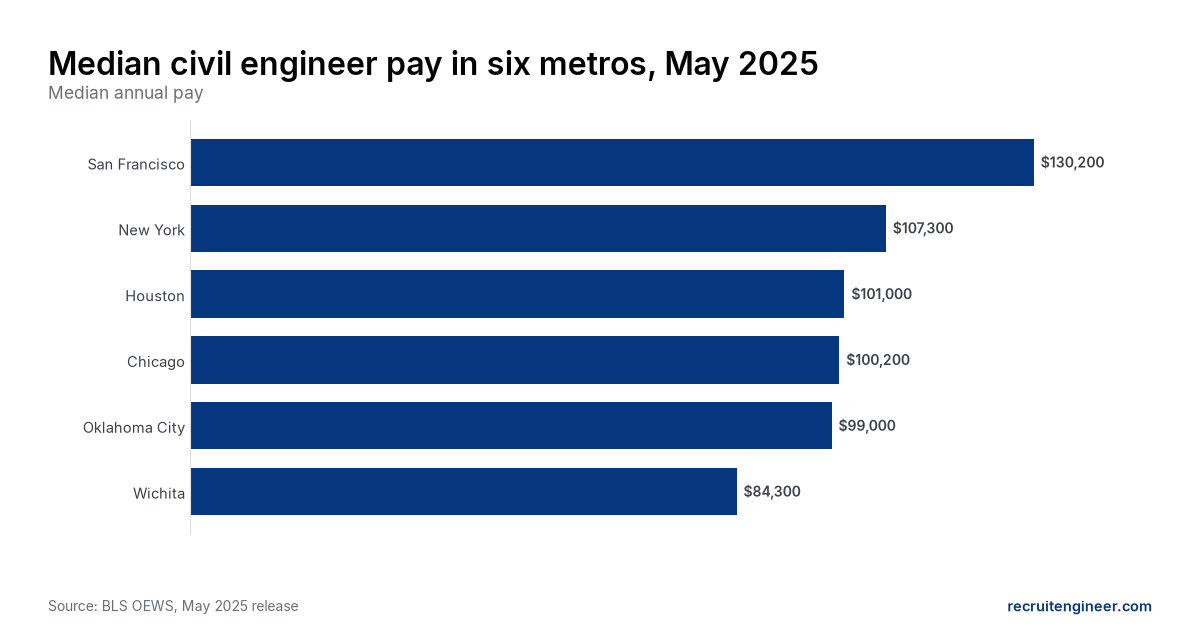
The typical civil engineer in the San Francisco area earns $130,200 a year. In the Wichita area the typical one earns $84,300 while doing more or less the same arithmetic about beams. So before you hire an overseas structural engineer to save money, notice that the US already has a big discount built into it, one that comes with a stamp attached.
Those are figures for civil engineers. The Bureau of Labor Statistics describes structural engineering as one of the specialties of civil engineering, so civil engineer pay is a fair stand-in. The same page says a licensed professional engineer is the one who can approve design plans and sign off on projects. An engineer overseas can do a great deal of the work on a US building. What they cannot do, without a license from the state where the building goes, is be the person who signs it. That is because state laws limit stamping and sealing designs to licensed professional engineers and there is no single nationwide license that lets an engineer practice across state lines.
What an overseas engineer can do on a US project
Start with what a seal means, because most of the answer is hiding in the definition. Texas writes it into its board rules: the seal assures the user that the work was performed or directly supervised by the engineer named on it, and on sealing the engineer takes full professional responsibility for that work. It does not say the engineer drew every line. It says they did the work or supervised it, so the drafting and the first pass at the calculations can be done by somebody else, including somebody in another country.
The supervising is what costs money. Texas defines direct supervision as control over and detailed professional knowledge of the work, with the engineer personally making decisions or personally reviewing and approving them before they are carried out. That control can come through physical presence or through communications devices. So as far as the definition goes, a Texas engineer could supervise a drafting team abroad over video calls. They still have to know the work in detail, which takes hours. Those are US engineering hours.
Illinois lets the engineer review instead
Illinois has its own statute on the structural engineer’s seal, which must carry the words Licensed Structural Engineer. Under the same section, an Illinois structural engineer may seal documents produced by others in two cases. Either those people worked under the engineer’s personal supervision and control, or the engineer reviewed the documents closely enough to be satisfied that they meet reasonable professional skill and diligence. On the review route the engineer is expected to perform whatever calculations or redesign the review calls for and to keep evidence of the review.
Either way, the person in the other country is doing work that a US licensee then owns. Sorted by task, the arrangement looks something like this.
| Task | Done overseas? | What has to be true |
|---|---|---|
| Drafting and modeling | Yes | The sealing engineer directly supervises it or reviews it closely before sealing |
| Analysis and calculations | Yes | The sealing engineer knows them in detail and redoes whatever the review finds wrong |
| Sealing the drawings | Only with a license from the project’s state | The seal belongs to an engineer licensed where the structure is built |
| Professional responsibility | Stays with the sealing engineer | In Texas, sealing means taking full professional responsibility for the work |
The license belongs to a state
Engineering licenses are issued state by state. That is why NCEES runs a Record service for engineers already licensed in one place who need licenses in other states, so they can avoid resending transcripts, exam results and references to each board. Every US state licensing board accepts the Record, though NCEES says it does not guarantee a license anywhere. The first transmittal for a comity application costs $175.
So the first thing to settle is whose seal goes on the set. It has to belong to an engineer licensed in the state where the structure will be built, who is willing to supervise or review the offshore work closely enough to put their name on it. Texas spells this out in its statute: plans for a project to be built or used in Texas must carry the seal of a Texas license holder. If an overseas firm offers you stamped drawings, it is offering you exactly that person, so it is fair to ask who they are and which state licenses they hold.
The overseas engineer could get licensed
Texas, for one, accepts applications from individuals from any country and holds them to the same standards as applicants from the US. A degree from outside the US that does not meet the education rules has to be evaluated by a board-approved company. At least two years of the experience claimed must be gained in the US or involve US design codes and standards. The structural exam NCEES offers, the PE Structural exam, is computer-based and split into vertical and lateral components that each have a breadth section and a depth section taken at separate appointments.
That path makes sense for someone you plan to employ for years, which is a different decision from sending out a set of drawings. For a single project it is far too slow to matter.
When a licensed US engineer is cheaper
Think about where the hours go on a structural job. Some are production, meaning the drafting and the sheet revisions. Some are judgment, like choosing the structural system and answering plan review comments. Offshore work is cheaper on the first kind. The second kind still has to be done or checked by the engineer whose seal goes on the set.
So an offshore team saves you the most when production is most of the job, say a run of similar buildings or a firm with steady drafting volume. It saves the least on a one-off building where judgment is most of the hours. There the US engineer’s review is most of the work, so you end up paying for much of the design twice.
Then there is the domestic discount. Pay for civil engineers varies a good deal from metro to metro, going by federal wage data for May 2025.
| Metro area | Civil engineers employed | Median civil engineer pay | Civil engineer pay at the 75th percentile |
|---|---|---|---|
| San Francisco | 10,990 | $130,200 | $163,200 |
| New York | 15,590 | $107,300 | $143,300 |
| Houston | 12,140 | $101,000 | $131,000 |
| Chicago | 9,760 | $100,200 | $126,600 |
| Oklahoma City | 880 | $99,000 | $131,200 |
| Wichita | 540 | $84,300 | $108,600 |
Say your firm is based in San Francisco, your projects are in Kansas and the plan was to send design work overseas to cut cost. A Kansas-licensed structural engineer hired around Wichita, where the typical civil engineer earns $45,900 less than in the San Francisco area, could do the whole job without a second review and without anyone waiting on a time zone. If your projects are in California instead, that Wichita engineer would need a California license just as an overseas engineer would. The difference is that an engineer who already holds a US license can apply for others by comity using an NCEES Record, rather than starting with a degree evaluation.
To tell which side of the line you are on, ask the licensed engineer who would seal the work how many hours they would spend checking an offshore set closely enough to put their name on it. Then ask how many hours they would spend designing it themselves. If the two numbers are close, the offshore step mostly adds a second team. You would do better hiring the engineer. If the review is a small fraction of the design, the offshore team is doing real work for you and the arrangement can pay for itself.
Where to start
Find the seal first. Work out which states your projects are in and find the engineer licensed there who will own the design. Only then decide how much of the production work goes overseas. If that engineer turns out to be someone on your own payroll, start by hiring a structural engineer licensed in the state where you build.