How to become an engineering manager, and whether to
Imagine a company that rewards its best engineer by taking away the engineering. Then, because that went well, it does the same to the next one and the next, until nobody is left to size the pump. That company would not last long. A milder version of it is how engineering management works, and it is mostly fine.
Real companies do this one engineer at a time and keep plenty of engineers around, which is sensible. So if you are working out how to become an engineering manager, the first question is whether you want the job it turns you into. The move is less a promotion than a change of profession that happens inside the same building. The pay goes up. The work turns into other people’s work.
The job is mostly other people’s engineering
The Bureau of Labor Statistics profile of architectural and engineering managers describes the job as making plans to research and develop products or designs, working out staff and equipment needs, proposing budgets for projects and hiring and supervising staff.
Notice what is missing from that list, which is sitting down and doing the calculation yourself. You still need to know whether the calculation is right, because that is how you can tell a project is about to go sideways before it does. But your output is now decisions about budgets and people. Your day fills up with the meetings that produce those decisions.
The same profile says working more than 40 hours a week is common for these managers, especially around deadlines. That is worth knowing before you compare salaries, because a raise that comes with a longer week is a smaller raise per hour than it looks.
One useful test is to think about the best week you had at work last year. If it was the week you solved a hard problem alone at your desk, management takes that week away from you more or less permanently. If it was the week a junior engineer finally understood something because you explained it well, that is roughly what the job is made of. The same goes for the week you got two teams to agree on an interface they had been arguing about for months.
How people actually make the move
The formal requirements are short. The BLS profile lists the usual route as a bachelor’s degree plus five years or more of work experience in a related occupation, which in practice means years as an engineer or architect. So the degree you already have is the degree you need, and the experience is something you build up by staying in the profession.
The harder part is getting evidence that you can manage before anyone lets you manage, which sounds circular and sort of is. The way around it is to collect pieces of the job while you are still an engineer. In rough order of how easy they are to get:
- Ask to lead something small, a design package or a test campaign, where other engineers bring their progress to you even though they report to someone else on paper.
- Take on a budget, even a modest one, because proposing and defending budgets is part of the job description and the skill is hard to fake in an interview.
- Get onto interview panels and write up what you thought of each candidate, since hiring and supervising staff is the other half of that description.
- Mentor a newer engineer on purpose with regular check-ins, so you find out whether you enjoy the slow work of making someone else better.
- Tell your own manager you want the role plainly and early, because a company cannot plan a succession around an ambition it has never heard about.
Your current employer is the easiest place to make the move, because the people deciding have already watched you lead the small project. Applying somewhere else for a first management job means persuading strangers with a line on a résumé. That line works much better once it says you led engineers and ran a budget, so you might do the steps first and shop the title second.
Whether you need a master’s degree
You can do without one. The BLS profile notes that some managers complete a master’s degree in engineering management while those interested in general management skills earn an MBA. If your employer will pay for one, take it, because it is a cheap signal that you are serious. If it will not, the degree is an expensive way to prove something a led project proves for free.
What it pays compared with staying an engineer
The BLS profile puts the typical pay of architectural and engineering managers nationally at $171,300 for May 2025. That figure covers every kind of engineering in every part of the country, so it is more useful to set managers against engineers in the same place.
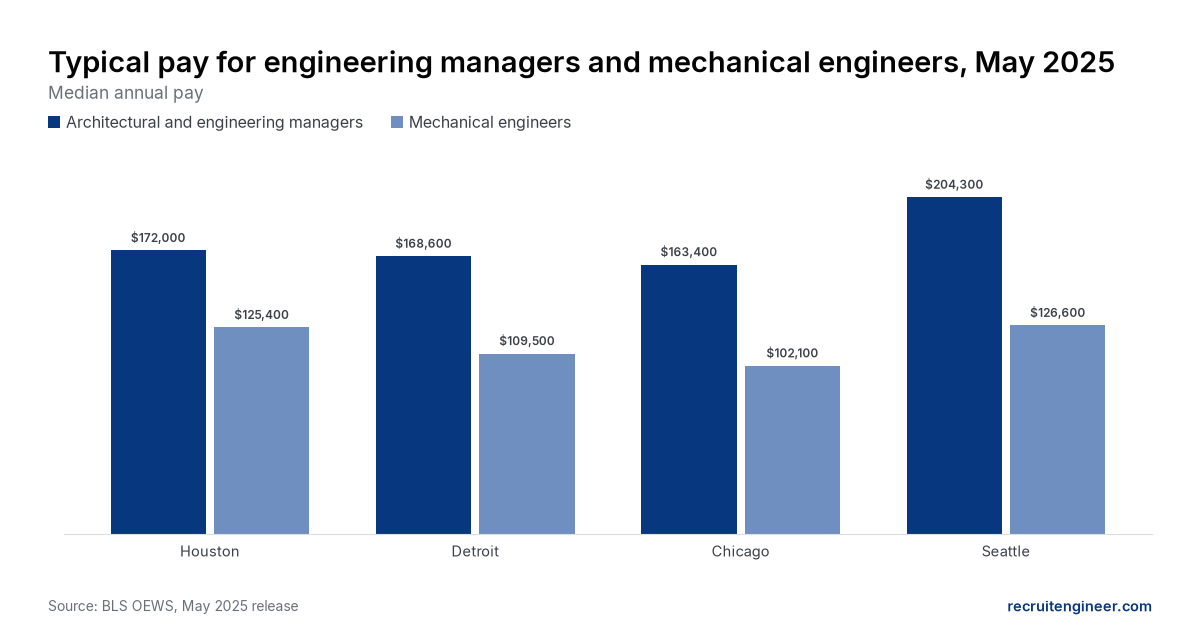
Federal wage data for May 2025 reports both by metro area. Mechanical engineers are one useful group to set managers against, and you can run the same comparison for whatever discipline you happen to be in.
| Metro | Typical engineering manager | Typical mechanical engineer | Difference |
|---|---|---|---|
| Houston | $172,000 | $125,400 | $46,600 |
| Detroit | $168,600 | $109,500 | $59,100 |
| Chicago | $163,400 | $102,100 | $61,300 |
| Seattle | $204,300 | $126,600 | $77,700 |
In these four metros the difference runs from $46,600 in Houston to $77,700 in Seattle. That is a large raise for changing jobs inside one building. You might read some of it as payment for the longer weeks and some of it as payment for being the person who answers for the budget when it goes wrong.
These are medians, so they compare a typical manager with a typical engineer. But the typical manager spent years as an engineer first, and the fairer comparison for you is with what you would earn by staying an engineer that long and getting good at it. A strong senior engineer already sits somewhere above the engineer median, which means the raise you would actually get is smaller than the difference column suggests. It is still a raise.
Whether to do it
The BLS projects employment of these managers to grow 6 percent from 2025 to 2035, which it describes as faster than average. So the seats are not going away, and you do not need to rush for one before they fill up.
Do it if you already like the parts of your current job that involve other people and a lead role has confirmed it. Do it if you find yourself more interested in why a project is late than in the problem that made it late. Think hard if the main attraction is the money, because the money comes attached to a job where weeks of more than 40 hours are common, especially when deadlines are close.
What to do next
If you are a mechanical engineer thinking about this, ask to lead the next design package that comes up and pay attention to how the first month feels. If you would rather see what lead and manager roles look like before you ask, start with our mechanical engineering practice and the metro pages linked from the pay table.