A mechanical engineer job description you can adapt
Think of a job description as a sieve that you pour the job market through. For a lot of jobs the sieve mostly sorts by seniority. A mechanical engineer job description has a harder time, because the same title covers someone sizing chillers for a hospital and someone designing gearboxes for a tractor. So the first line of yours has to say which one you mean.
Once you have decided that, most of the rest follows. The duties follow from the kind of work, the tools follow from the duties and the pay line follows from the level and the place. The pay line looks like the hard part, but it is the easiest part to check because there is decent public data on what mechanical engineers earn.
Decide which mechanical engineer you mean
Mechanical engineers are spread across a lot of industries. The federal Occupational Outlook Handbook entry for mechanical engineers puts 20 percent of them in architectural, engineering and related services and 14 percent in machinery manufacturing.
For a job description, that spread reduces to two families. One family designs the heating, cooling and plumbing systems inside buildings. If your drawings get stamped before they go out for a permit, you are hiring from this family. The other family designs products and equipment such as pumps, engines and medical devices, where the work gets proved by building and testing a prototype.
The licensing exam draws much the same line. The PE Mechanical exam from NCEES comes in three versions, each with its own specification:
- HVAC and Refrigeration, for building systems work
- Machine Design and Materials, for product and equipment design
- Thermal and Fluid Systems, for heat transfer and fluid flow work
So the license line in your description depends on the family. If your engineers will stamp building drawings, ask for a PE at the senior level and ask juniors to be working toward one. If they design products, you can probably leave the PE off the requirements, because asking for a credential the work does not use mostly shrinks the pool of people who apply.
The template at three levels
Title and summary
Use a plain title such as Mechanical Engineer I or Senior Mechanical Engineer. Then put the family in the first sentence of the summary, something like this:
We are hiring a mechanical engineer to design [the product, equipment or building system] for [the customer or building type]. You will take your designs from first calculations through drawings and testing. You will work with [manufacturing, the contractor or the client] and report to [title].
Duties by level
The federal handbook describes the job as a chain: analyze a problem, design a device using computer-aided design, build and test prototypes, then oversee its manufacture. A job description at each level is mostly a statement of how much of that chain one person owns.
| Duty area | Entry level (Engineer I) | Mid level (Engineer II) | Senior engineer |
|---|---|---|---|
| Design | Produces models and drawings for parts and assemblies, with every design reviewed | Owns the design of a subsystem from requirements to release | Sets the design approach for a whole product or building and signs off on it |
| Analysis | Runs hand calculations and standard simulations that someone else set up | Chooses the analysis method and defends the results in design reviews | Decides what needs analysis and reviews the work of other engineers |
| Testing and failure analysis | Builds test setups and records the results accurately | Plans tests, reads the results and changes the design | Leads investigations into field failures and recommends fixes |
| Production or construction support | Answers routine questions from the shop floor or the site | Works with manufacturing or the contractor to resolve problems | Owns the handoff to production or construction |
| People | Learns the product and the standards from a senior engineer | Guides one or two junior engineers day to day | Mentors the team and works directly with clients or customers |
Tools to name
Name the tools you actually use, rather than every tool that exists. A candidate who has used your CAD package will be productive sooner, but one who knows a different package can probably learn yours, so treat the software as a preference unless the role is mostly drafting.
- CAD: name the package, for example SolidWorks, Creo, NX or Revit for building work
- Analysis: finite element or fluid flow software such as ANSYS, plus hand calculations
- Drawings: geometric dimensioning and tolerancing (GD&T) for product roles
- Building roles: the load calculation and energy modeling software your firm uses
- Everyone: spreadsheets or MATLAB for the calculations that fit nowhere else
Qualifications
| Requirement | Entry level (Engineer I) | Mid level (Engineer II) | Senior engineer |
|---|---|---|---|
| Education | Bachelor’s degree in mechanical engineering or mechanical engineering technology | The same bachelor’s degree, with a master’s degree as a plus | The same bachelor’s degree, with experience counting for more than further study |
| Experience | Internships, co-ops or a capstone design project | Three to six years designing similar products or systems | Eight or more years, including ownership of a complete design |
| License | FE exam passed or planned within the first year | FE passed and working toward a PE where the work is stamped | PE required if the role stamps drawings, otherwise optional |
The education line comes from the federal handbook, which says mechanical engineers typically need a bachelor’s degree in mechanical engineering or mechanical engineering technology. The same handbook says a PE license generally takes a passing score on the FE exam, relevant work experience of typically at least four years and a passing score on the PE exam. So a PE in the entry column would be asking for something the candidate cannot have yet.
Writing the pay line
The pay line has two jobs. It tells candidates whether to bother applying, and for some employers it is a legal requirement. In Washington, the Department of Labor and Industries says employers with 15 or more employees must include a wage scale or salary range in job postings, along with a general description of benefits. The range should run from the lowest to the highest pay the employer set before posting the job.
Start with the level
Advertised pay sorts fairly neatly by level. Here is our analysis of about 5,700 engineering job postings that listed pay, collected by The Hiring List and first seen in the 60 days to November 9, 2026. Each posting counts once, at the midpoint of its advertised base pay range.
| Mechanical engineer level | Postings | 25th percentile | Median | 75th percentile |
|---|---|---|---|---|
| Entry | 541 | $77,500 | $84,500 | $95,000 |
| Mid | 2,580 | $95,000 | $112,500 | $132,500 |
| Senior | 2,616 | $122,700 | $142,400 | $162,500 |
| All levels | 5,737 | $100,000 | $124,000 | $149,200 |
The levels overlap quite a bit. The bottom quarter of senior postings pays less than the top quarter of mid-level postings, so a strong Engineer II and a modest senior hire cost roughly the same. Pick the band that matches the duties you wrote and post the middle half of it, from the 25th to the 75th percentile.
Then adjust for the metro
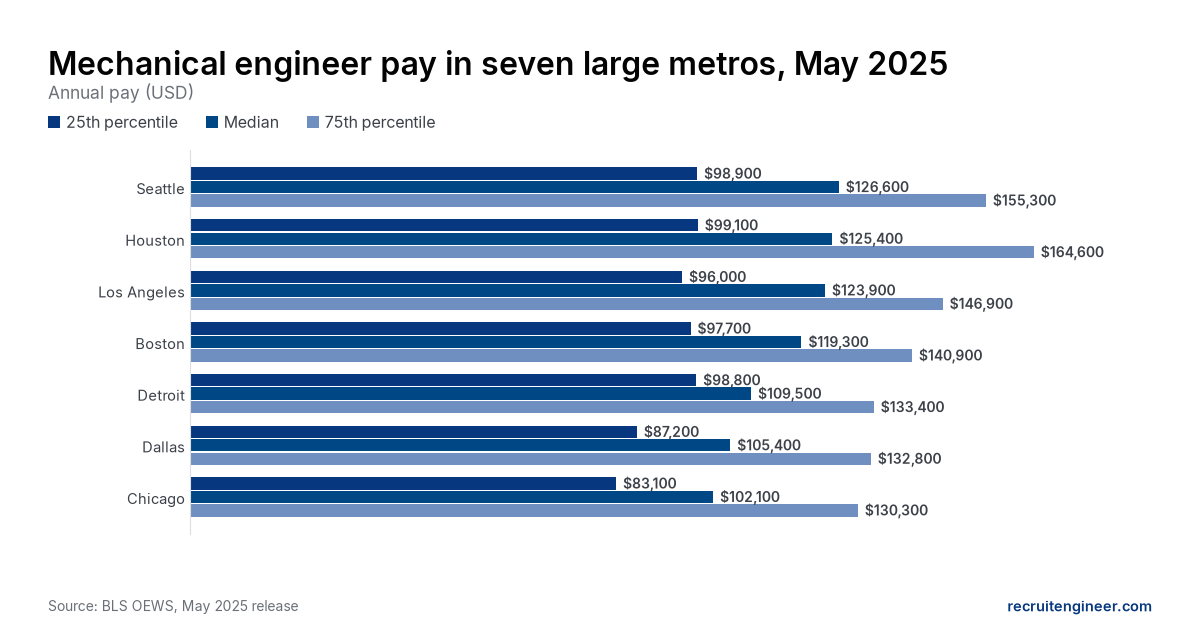
To fit that range to a place, look at what mechanical engineers in the metro actually earn. The BLS Occupational Employment and Wage Statistics tables give federal wage data for May 2025 by metro.
| Metro | Mechanical engineers employed | 25th percentile | Median | 75th percentile |
|---|---|---|---|---|
| Seattle | 4,500 | $98,900 | $126,600 | $155,300 |
| Houston | 8,310 | $99,100 | $125,400 | $164,600 |
| Los Angeles | 8,780 | $96,000 | $123,900 | $146,900 |
| Boston | 6,890 | $97,700 | $119,300 | $140,900 |
| Detroit | 22,500 | $98,800 | $109,500 | $133,400 |
| Dallas | 5,600 | $87,200 | $105,400 | $132,800 |
| Chicago | 6,900 | $83,100 | $102,100 | $130,300 |
Detroit employs about 22,500 mechanical engineers, far more than any other metro listed, but its range is narrow. Its 25th percentile is close to Houston’s while its 75th is $31,200 lower. So a senior range topping out at $162,500 would sit above most of the Detroit market and still inside the Houston one.
Chicago and Dallas sit at the low end of this group at all three percentiles. If you are hiring there, you might set a senior range closer to the local figures than to the advertised senior band.
A pay line you can paste
Put together, a mid-level line for a search that is open to the whole country looks like this:
Pay: $95,000 to $132,500 base salary depending on experience, plus [bonus] and benefits including [health plan, retirement plan and paid time off].
For a senior role in Houston you could stretch the top toward $164,600, because a quarter of mechanical engineers there earn more than that. For the same role in Chicago you might keep the top of the range closer to the national senior median.
What to do next
Write the family into the first sentence, pick the level from the duties you listed, then take the range from advertised pay at that level and nudge it with the metro figures. If you would rather hand the search over once the description is written, start with Recruit Engineering’s mechanical engineering practice.