Sometimes the industrial engineer is the expensive hire
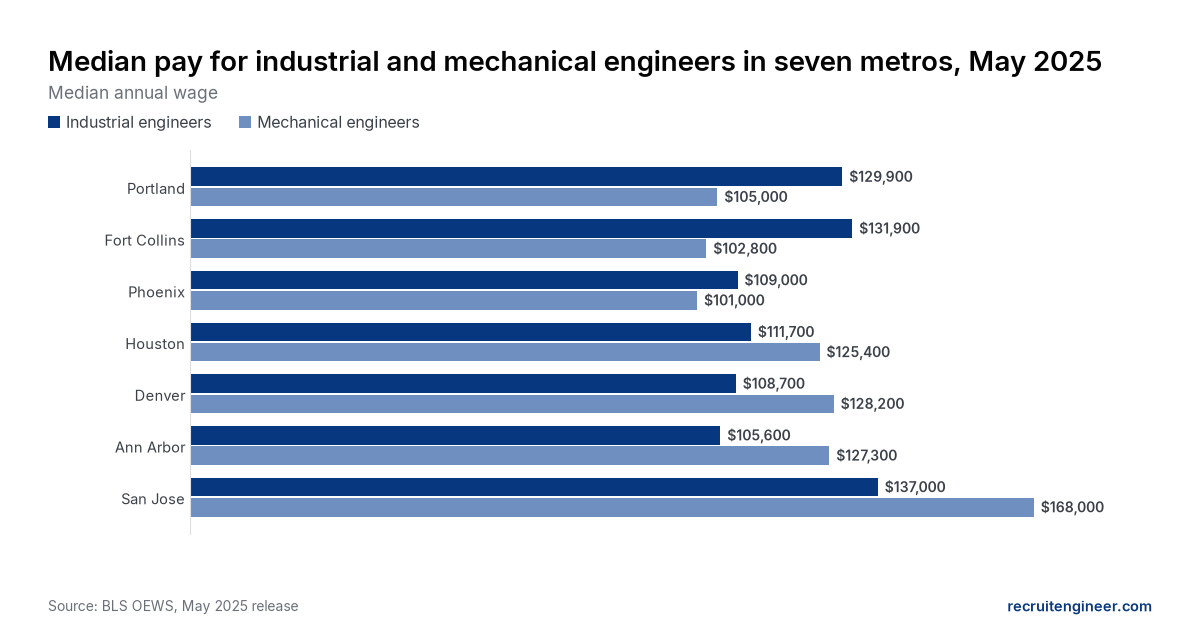
In the Portland metro, the typical industrial engineer earns $24,900 more than the typical mechanical engineer. That is strange, since in Chicago and Boston the two jobs sit within a few hundred dollars of each other. Asked which engineer a plant pays more, you would probably pick the one who designs the product over the one who speeds up production. In Portland that guess is badly off.
It would be convenient if every city had one price for an engineer with small adjustments by discipline, because then you could look up one number and move on. Some cities behave roughly like that. Others pull the two disciplines apart in opposite directions by enough to wreck a pay band that was built on the wrong one.
A dozen metros with two medians each
Here are both numbers for twelve metros from federal wage data for May 2025. The median is the pay of the engineer standing in the exact middle of the line, so half earn more and half earn less.
| Metro | Industrial engineer median | Mechanical engineer median | Paid more | Gap |
|---|---|---|---|---|
| Fort Collins-Loveland, CO | $131,900 | $102,800 | Industrial | $29,100 |
| Portland-Vancouver-Hillsboro, OR-WA | $129,900 | $105,000 | Industrial | $24,900 |
| Phoenix-Mesa-Chandler, AZ | $109,000 | $101,000 | Industrial | $8,000 |
| Seattle-Tacoma-Bellevue, WA | $131,200 | $126,600 | Industrial | $4,600 |
| Minneapolis-St. Paul-Bloomington, MN-WI | $104,700 | $101,200 | Industrial | $3,500 |
| Chicago-Naperville-Elgin, IL-IN | $101,800 | $102,100 | Mechanical | $300 |
| Boston-Cambridge-Newton, MA-NH | $119,000 | $119,300 | Mechanical | $300 |
| Detroit-Warren-Dearborn, MI | $104,100 | $109,500 | Mechanical | $5,400 |
| Houston-Pasadena-The Woodlands, TX | $111,700 | $125,400 | Mechanical | $13,700 |
| Denver-Aurora-Centennial, CO | $108,700 | $128,200 | Mechanical | $19,500 |
| Ann Arbor, MI | $105,600 | $127,300 | Mechanical | $21,700 |
| San Jose-Sunnyvale-Santa Clara, CA | $137,000 | $168,000 | Mechanical | $31,000 |
The places at the top are not simply places where engineers are expensive. Phoenix pays its mechanical engineers less than Detroit does and still pays its industrial engineers more than Detroit. The places at the bottom are not cheap either, since San Jose sits there with the highest industrial engineer pay of the twelve. What changes from row to row is the order of the two jobs, which is a different thing from the level.
So if you set a process hire’s pay off what you already pay your design engineers, you would be about right in Chicago, too generous in Denver and short in Portland.
The more common engineer gets paid more
One theory for a gap like this is scarcity, where you pay more for the kind of engineer there are fewer of. That theory says Portland should be short of industrial engineers. The headcounts say roughly the opposite.
| Metro | Industrial engineers employed | Mechanical engineers employed |
|---|---|---|
| Portland-Vancouver-Hillsboro, OR-WA | 5,230 | 2,520 |
| Minneapolis-St. Paul-Bloomington, MN-WI | 13,970 | 4,450 |
| Detroit-Warren-Dearborn, MI | 17,350 | 22,500 |
| Ann Arbor, MI | 930 | 2,280 |
Portland has about 5,200 industrial engineers against about 2,500 mechanical engineers, so the better-paid discipline is also the more plentiful one by roughly two to one. Ann Arbor runs the same pattern in reverse, with more than twice as many mechanical engineers as industrial engineers and the mechanical engineers earning more. Minneapolis and Detroit line up the same way. In all four metros the more common engineer is also the better-paid one.
Four metros is not a law of nature. But it fits a simple story. A city with a lot of one kind of engineer probably has a lot of employers who need that kind of engineer, so they bid against one another. On that reading the plentiful engineer is plentiful because demand is high, and high demand is also what lifts the price.
For an employer this is mildly annoying. The market with the most candidates tends to be the one where each candidate costs more, so the easy search and the cheap search are in different cities.
Price the process hire on its own
Say you run a plant in the Portland area and you set the pay for an industrial engineer by borrowing the mechanical engineer number you already know. You would offer around $105,000 to someone whose typical local peer earns $129,900. The people who say yes would mostly be the ones sitting below the middle of their own market, which is an odd way to staff a continuous improvement program.
Now run it the other way in Denver. Anchoring on the design number there overpays the process hire by $19,500 at the median. That is a nicer problem to have. It is still money you did not need to spend and the next industrial engineer you hire will expect the same band.
If you are filling industrial engineering or manufacturing engineering roles, price them from the industrial engineer row for your metro rather than from the mechanical row. You can set industrial engineering pay in Portland next to industrial engineering pay in Ann Arbor or line every discipline up in the engineering salary guide.
The split mostly happens above the bottom quarter
Medians describe the engineer in the middle. If you are hiring someone earlier in their career, the 25th percentile is a better rough guide, since it is the pay of the engineer a quarter of the way up the line from the bottom.
| Metro | Industrial engineer 25th percentile | Mechanical engineer 25th percentile | Paid more | Gap |
|---|---|---|---|---|
| Portland-Vancouver-Hillsboro, OR-WA | $102,200 | $95,600 | Industrial | $6,600 |
| Houston-Pasadena-The Woodlands, TX | $92,700 | $99,100 | Mechanical | $6,400 |
| Denver-Aurora-Centennial, CO | $95,200 | $98,600 | Mechanical | $3,400 |
| Ann Arbor, MI | $95,700 | $98,400 | Mechanical | $2,700 |
Down here the two disciplines are much closer. The order stays the same in all four metros but the gaps shrink to a few thousand dollars. Portland’s industrial engineer premium is roughly a quarter of its size at the median, while Ann Arbor’s mechanical premium nearly disappears.
So the pricing problem is mostly a problem in the middle of the range. If you are hiring an early-career process engineer in Ann Arbor, borrowing the mechanical number costs you very little. If you are hiring an experienced one in Portland, the borrowed number is where the offer goes wrong, because the middle of the range is where the two jobs have drifted apart. You could reasonably use one pay band for junior industrial and mechanical engineers in most of these cities and then split the band as people move toward the middle.
Where you might look first
If the hire is a process or quality engineer and the location is flexible, the metros where the mechanical engineer is the expensive one deserve a look. In Ann Arbor, Houston and Denver the industrial engineer costs well under the local mechanical engineer. Ann Arbor in particular pays its industrial engineers about what Detroit does, which is a little surprising for a place that pays design engineers so much more.
If the hire is a design engineer, flip it. Phoenix and Fort Collins pay mechanical engineers less than they pay industrial engineers, and both sit near the Chicago level for mechanical work. Seattle is high on both counts, so it is a place you go for the people rather than the price.
For a process search you might open in Ann Arbor or with industrial engineers in Houston and budget at the local industrial engineer median, then add Portland only if the job has to sit there. For a design search, mechanical engineers in Phoenix are the first ones worth pricing. In both cases you would look up the specific discipline for the specific city before writing an offer, because the two numbers do not travel together from one metro to the next.