Electrical pay bands run widest in Austin and Raleigh among large metros
Line up every electrical engineer in a city by salary, lowest to highest, then set aside the bottom quarter and the top quarter. What remains is the middle half of the market. The distance from its floor to its ceiling tells you how far you can trust the word typical when you set a salary. In Austin that distance is $91,800.
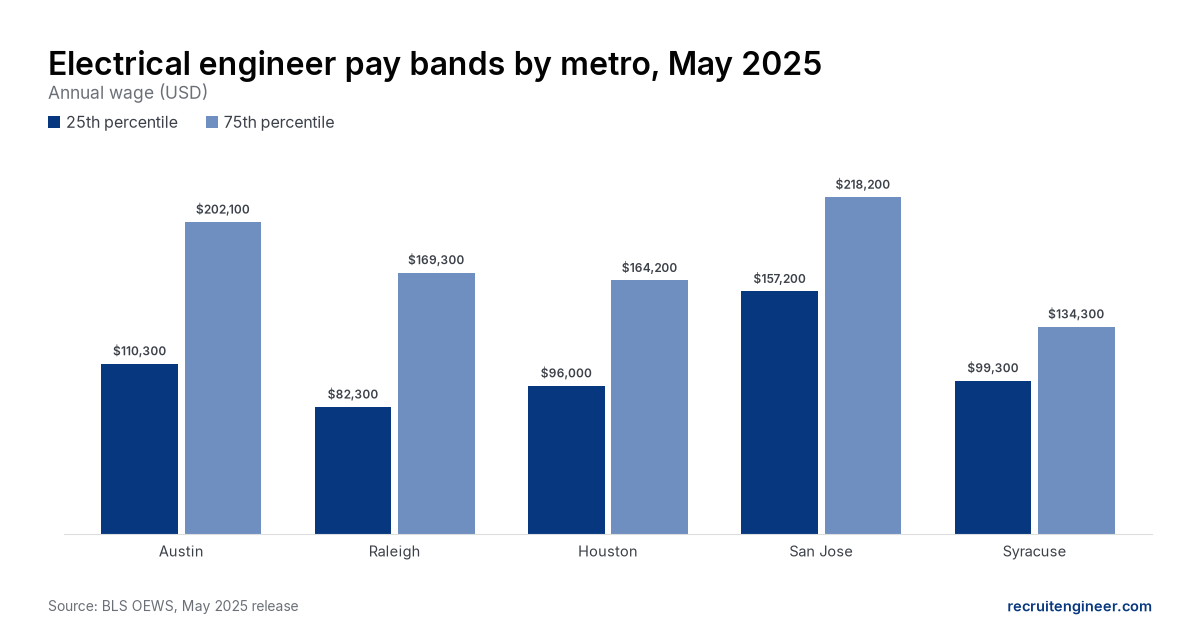
The floor of that middle half is the 25th percentile and the ceiling is the 75th. The federal statisticians describe a percentile wage as a boundary between the workers paid less and the workers paid more, so the median is just the boundary in the exact middle. In federal wage data for May 2025 the Austin band runs from $110,300 to $202,100.
So two Austin employers can be about that far apart on the same job title while both pay what the data would call a normal wage. Neither one is an outlier. If you set an offer at the median you have picked one point in a very wide range. Whether it is a good point depends entirely on who you are trying to hire.
Austin and Raleigh have the loosest bands
Among the metros we cover with at least 500 electrical engineers and all three wage figures reported, Austin has the widest middle half. Raleigh comes second and Syracuse sits among the narrowest. Two bigger markets sit in between for comparison.
| Metro | Electrical engineers employed | 25th percentile | Median | 75th percentile | Width of the middle half |
|---|---|---|---|---|---|
| Austin, TX | 4,070 | $110,300 | $145,400 | $202,100 | $91,800 |
| Raleigh, NC | 1,500 | $82,300 | $130,200 | $169,300 | $87,000 |
| Houston, TX | 5,770 | $96,000 | $131,100 | $164,200 | $68,200 |
| San Jose, CA | 4,160 | $157,200 | $187,100 | $218,200 | $61,000 |
| Syracuse, NY | 700 | $99,300 | $111,100 | $134,300 | $35,000 |
Houston has the most electrical engineers in the group at about 5,800, yet its band is much tighter than Austin’s. So a bigger market does not automatically mean a looser one. San Jose pays far more than anywhere else listed and still runs a narrower band than Houston. Its 25th percentile is higher than the Austin median, which tells you that in San Jose the floor is high for everyone and an offer mostly has to clear it.
Syracuse is easy in a different way. It has about 700 electrical engineers and its whole middle half is narrower than the stretch from the Austin median up to the top of the Austin band. The median there is a decent guess at what most hires will cost, so getting it slightly wrong is cheap.
Put the two ends side by side and something a little odd falls out. The bottom of the Austin band sits within $800 of the Syracuse median. So an Austin employer hiring at the low end of its market pays roughly what a Syracuse employer pays for the typical engineer in its own market. That is a reasonable result, since Austin engineers in that bottom quarter are presumably earlier in their careers. It does mean that city-to-city comparisons of medians tell you less than they seem to, because the median in a wide band and the median in a narrow band are describing quite different shapes.
Austin stretches up and Raleigh stretches down
Width is only half of it. Where the median sits inside the band is a separate question, and the two widest bands lean in opposite directions.
In Austin the median sits $35,100 above the bottom of the band and $56,700 below the top. Most of the width is up at the top, where a minority of engineers earn a great deal more than the typical one. If the person you want is in that minority, an offer built on the median will be short by a lot. The candidate will probably know it before you do.
Raleigh leans the other way. Its median sits $47,900 above the bottom of the band and $39,100 below the top, so the stretch is underneath. That points to a lower-paid quarter of the market sitting well under the middle, which is good news if you are hiring early-career engineers there. A median offer to a recent graduate in Raleigh may be generous. Generous is fine, though it costs money and it sets the starting point for every later raise.
Say you are hiring for the same role in both cities at once. At the median the Austin offer is $15,200 higher than the Raleigh one, which sounds like the whole story. But if the Austin hire is senior and the Raleigh hire is a recent graduate, the honest offers are the top of the Austin band and the bottom of the Raleigh band. Those are $119,800 apart for what the job board calls the same job.
One job title covers several jobs
Part of why a band gets wide, you might guess, is that the title covers different kinds of work. Before you place an offer for electrical engineering work it helps to separate power and plant controls from electronics development. Ask about voltage levels, equipment and design ownership. Ask whether the person tests or commissions what they design. Those answers tell you roughly which quarter of the band the person belongs in.
The federal wage tables also publish a separate row for electronics engineers. In Austin the typical electronics engineer earns $163,000 against $145,400 for the typical electrical engineer, a gap of $17,600. If the work looks more like electronics design than power or controls, check the electronics row too, because in Austin it sits noticeably higher.
The top of a band has one more wrinkle. The federal survey leaves out stock bonuses and year-end bonuses when it counts wages. So if you compete for senior people against employers that pay partly in stock, the 75th percentile understates what the candidate is comparing your offer with.
Decide the level before the number
A workable way to set an offer in a wide band is to settle the level first and let the number follow. Someone a year or two out of school who works from other engineers’ designs belongs near the bottom of the band. Someone who owns designs and signs off their own testing is a median hire. Someone who leads commissioning or owns high-voltage work belongs near the top. In Austin the top is a long way up.
The cost of getting the level wrong grows with the width of the band. Mistaking a senior Austin engineer for a median one leaves you $56,700 short of the top of the band, which is more than a third of the Austin median. In Syracuse the same mistake costs $23,200.
In a narrow band you can more or less post the median and adjust. In a wide one the median answers a question you did not ask, which is what the middle engineer in the city earns, when what you want to know is what this particular engineer earns.
What to do next
If you are hiring electrical engineers in Austin or Raleigh, write down the level and the specialism before anyone mentions a number. Then pick the percentile that matches it. For a role that straddles disciplines, set the electrical figures beside neighboring disciplines in the engineering salary guide before you fix a band.