How to hire architectural engineers, and how the role differs from MEP and structural

Suppose you wanted one engineer to design a whole building, meaning the steel and the ductwork and the wiring and the lighting and the order in which the contractor puts all of it in. You would be asking for several engineers in one person, and you would probably not find them. Architectural engineering is roughly what you get when you walk that idea back to something reasonable.
The reasonable version is an engineer who designs one building system properly and understands the others well enough to keep them out of each other’s way. That is a useful person to have on a building project, as long as you know which version of them you are hiring. If you set out to hire architectural engineers, you are really choosing between three hires: an architectural engineer, an MEP engineer or a structural engineer.
What an architectural engineer actually designs
The degree gives the cleanest definition, because the accreditor writes it down. Under ABET’s criteria for architectural engineering programs the curriculum covers four areas: building structures, building mechanical systems, building electrical systems and construction (or construction management). A student has to reach design level in one of them, application level in a second and comprehension level in the remaining two. The same criteria require the basic concepts of architecture, taught through architectural design and history.
So an architectural engineer is a specialist with a spare set of fluencies. One graduate designs HVAC systems and can read a structural drawing without flinching. Another designs the frame and understands why the mechanical engineer wants a large hole through that particular beam. The design-level area is the thing you are actually paying for. The rest is what makes the person easy to coordinate with, which is worth real money on a building where every system wants the same few inches of ceiling space.
Architectural, MEP or structural
Those three titles overlap enough that the choice comes down to what your project is missing. An MEP engineer designs mechanical, electrical and plumbing systems. A structural engineer designs the frame that holds the building up. An architectural engineer can be either of those, plus some training in making the pieces fit together and fit the architecture.
| What your project is missing | The hire you probably want | Degrees worth considering |
|---|---|---|
| Someone to design HVAC, power, lighting or plumbing | An MEP engineer or an architectural engineer whose design area is mechanical or electrical | Mechanical, electrical or architectural engineering |
| Someone to design the structural frame | A structural engineer | Civil, structural or architectural engineering |
| Someone to make the systems fit each other and the architecture | An architectural engineer with design experience in one system | Architectural engineering, or mechanical and electrical with long building experience |
| Someone to seal drawings for a discipline | A licensed PE | Any of these, plus the license |
If you are an A/E firm whose mechanical group keeps losing arguments with its structural group, the architectural engineer is the person who might settle them. That is a strange thing to put in a job title. You can put it in the job description, though, and you should.
When the job needs a PE
Licensing happens state by state through each state’s board. NCEES, the council of state licensing boards, notes that only a licensed engineer can prepare, sign, seal and submit engineering drawings. So the first question about any of these jobs is whether the person will seal anything. If they will, the job needs a licensed engineer. For an architectural engineer that raises a slightly odd second question about which license.
NCEES offers a PE Architectural Engineering exam, given on a single day each year and designed for engineers with at least four years of work experience after college. ASCE’s Architectural Engineering Institute lists its content as building systems integration plus electrical, mechanical and structural systems, along with project management and construction administration. The same page says the exam is not recognized in Alaska, California, Hawaii, Nevada or Oregon. It also tells candidates to confirm with their own board before they sit it.
A few states add their own wrinkles. Washington’s licensing board licenses architectural engineering under the name Building Systems Engineer, so a Washington posting that asks for an architectural engineering PE is asking for something the state calls by another name. Illinois licenses structural engineers separately under its own Structural Engineering Practice Act. If you are hiring architectural engineers in Chicago for work that touches structure, check with the state whether the work calls for that structural license rather than a PE.
The more common mistake runs the other way. If the person will not seal anything for their first couple of years, requiring a PE on day one shrinks an already small pool for a benefit you cannot point to. Say instead that you expect the license within a set period and that you will support the exam. If your buildings are in one of the states that skip the architectural exam, ask candidates which discipline their license is in and make sure it matches the drawings they will seal.
Where the candidates come from
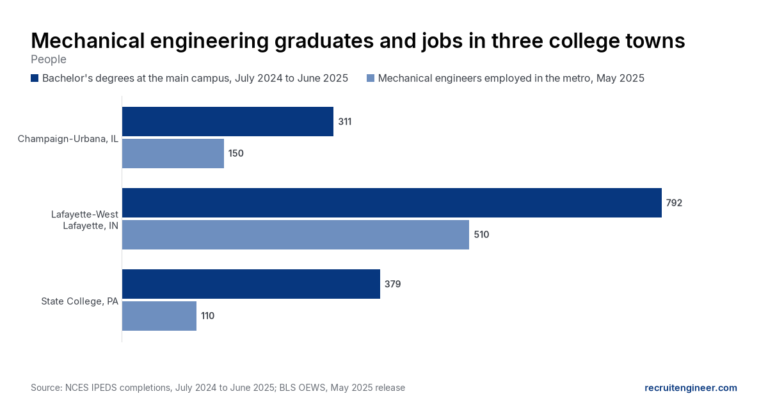
One school that offers the degree shows how its graduates stack up against the neighboring disciplines. Federal degree data for July 2024 to June 2025 from the Integrated Postsecondary Education Data System shows what Pennsylvania State University-Main Campus awarded in four engineering disciplines.
| Discipline | Bachelor’s degrees, July 2024 to June 2025 |
|---|---|
| Architectural engineering | 95 |
| Civil engineering | 190 |
| Electrical and electronics engineering | 126 |
| Mechanical engineering | 379 |
At that school mechanical graduates outnumber architectural ones about four to one. So if you insist on the architectural engineering degree, you are choosing the smaller pool on purpose. That can be the right call for a role that is mostly coordination. For a role that is mostly designing one system, the bigger pool is mechanical engineers and electrical engineers who went into building work after graduating.
You give up the coordination training that the accredited curriculum requires. But an engineer who spent five years designing HVAC or power distribution for commercial buildings has probably picked up a fair amount of it in clash meetings, which is a more expensive classroom but still a classroom. The same reasoning points toward civil graduates with building experience when the role is mostly about the frame, which is closer to a structural engineering hire than an architectural one.
What to put in the posting
A posting that only says architectural engineer describes at least four different people. You want the right one to recognize themselves, so be specific about the work.
- Name the design-level discipline, for example mechanical design for commercial buildings or electrical design for healthcare facilities.
- Say which systems the person designs and which ones they only coordinate.
- Say whether the job seals drawings and in which discipline and state the license must be held.
- If the license can come later, say how long the candidate has to get it and whether you pay for the exam.
- Describe the building types and rough sizes, because a lab full of fume hoods and a warehouse are very different jobs for a mechanical engineer.
- List the design and modeling software the team uses every day.
- Give the pay range so candidates can tell quickly whether the job is for them.
Building type matters more than it looks. A posting for architectural engineers in New York City that says high-rise residential will draw a different set of applicants from one that says hospitals, which is the point of saying it.
Project questions for the interview
Interviews for this role go better when they stay on one real building. Ask the candidate to pick a completed project and then keep them on it with questions like these.
- Which systems on that building did you design yourself, and which did you check or coordinate?
- Walk through one clash with another discipline: what collided, who moved and why.
- What load or calculation drove the biggest design decision on the project?
- Which code or standard governed the hardest part of your design?
- What did the building do after it opened that you did not expect?
- Did you seal any of the drawings, and if so in which discipline and state?
A candidate whose design area is mechanical should be able to talk about loads and equipment selection at length. Any architectural engineer should be able to talk about the clash, and that answer is the one that separates them from a pure MEP hire. If they cannot remember a clash, they either had an unusually lucky project or were not in the room when it was resolved.
What to do first
If you are still unsure which of the three you need, write down the one system you most need someone to design and whether anyone in the job will have to seal drawings. Those two answers settle most of it. If the answer is architectural engineering, write the posting around the design discipline and open it to mechanical and electrical engineers with building experience. If you would rather hand the search over, you can start one with Recruit Engineering from the architectural engineering practice page.