Hiring during a recession when you still need engineers
The Bureau of Labor Statistics projects that civil engineering will add about 24,500 jobs over a full decade. It also projects about 22,700 openings in every single year of it. So each year opens almost as many jobs as the decade adds, because most openings come from engineers who retire or switch careers on their own schedule.
If you are hiring during a recession, or deciding whether to stop, this is a useful thing to keep in mind. A hiring freeze stops the new jobs. It does not stop the old ones from emptying. So the question for an engineering manager is less about whether to freeze and more about which open requisitions are attached to work that will still exist in a year. That question has a fairly mechanical answer.
Which engineering roles stay open in a slowdown
An engineering requisition is a small bet that there will be work for the person you hire. Some of those bets are already settled. If a state transportation department has awarded your firm a bridge design contract, the money exists and so does the deadline. The BLS notes that public projects may depend on government funding and that civil engineering employment can fluctuate with the availability of project funds. That cuts both ways, because a project waiting on a budget vote is a forecast and not a contract.
Licensure makes funded roles stickier still. A licensed Professional Engineer is the person who can approve design plans and sign off on projects, which means the job cannot be quietly absorbed by whoever is left on the team after a freeze. If your PE retires halfway through a funded project, you hire another one, recession or not. Long backlogs work the same way. If your power or controls group sold a substation upgrade or a plant automation job last year, that work still has to be designed and commissioned on the dates in the contract.
The roles that go first are the ones attached to a forecast. A product team hired to build something the company hopes customers will want next year is a reasonable bet in a boom. In a slowdown it is an expensive one, because the revenue it was hired to chase is exactly what a recession postpones.
The discipline label protects nobody
It is tempting to sort this by degree and decide that electrical engineers are safe. In the second quarter of 2009, IEEE Spectrum reported that unemployment among electrical engineers reached 8.6 percent, a record by IEEE-USA’s count. An electrical engineer on a utility’s grid program and one on a consumer gadget team have the same title and very different funding. So when you sort your electrical engineering openings, sort them by who is paying for the work.
Rank every open requisition by funding and lead time
Put every open engineering requisition in one list and ask two questions of each one. Is the work it supports already paid for? How long would it take to refill the seat if you closed it now and reopened it later? Funding tells you whether you need the person, while lead time tells you how badly a pause will hurt if the money shows up after all.
| If the requisition looks like this | What to do with it |
|---|---|
| Funded project with a licensed role and a long search | Keep it open and keep interviewing |
| Funded project with a role that is easy to fill | Keep it open but feel free to slow the pace |
| Funding expected but not signed, with a long search | Keep candidates warm and hold the offer until the money is signed |
| Speculative product work that is easy to fill | Pause it and tell the candidates already in process |
| A short peak of work on a funded project | Cover it with a contract engineer instead of a new hire |
The lead time column is the one people tend to skip. A senior licensed engineer you need in nine months might take most of those nine months to find, so freezing that search today is really a decision to start late. If the project gets cancelled, you have spent some interview hours. If it goes ahead, you have saved nothing and lost a quarter.
A downturn is a decent time to hire senior engineers
Recessions do one helpful thing for employers who still have funded work. In BLS annual averages, the unemployment rate for architecture and engineering occupations was 3.1 percent in 2008. A year later it was 6.9 percent. The number of unemployed people in those jobs went from about 95,000 to about 203,000.
Some share of a number like that is likely to be senior engineers whose projects were cut, which says nothing about how good they are at the work. If you have a funded civil or power program and a senior opening that sat empty through the good years, you might fill it now. It feels a little awkward to hire when finance most wants you not to. But a senior engineer is the hire whose absence costs you the most time later.
The employed seniors are a different story. An engineer with a steady job may be reluctant to become the newest person at a new firm just as cuts arrive, so the pool of available people grows while the pool of movable people may shrink. If you want one of the movable ones, show them the funded project and the budget line behind the role, then give them a start date that will not slide.
Contract engineers cover the peak without new headcount
Some work arrives in a lump, like a permit deadline or a commissioning window. If you staff for the lump with permanent hires, you are overstaffed once it passes. A contract engineer is paid by the hour and leaves when the work does, which is the whole point in a year when headcount is the number finance is watching.
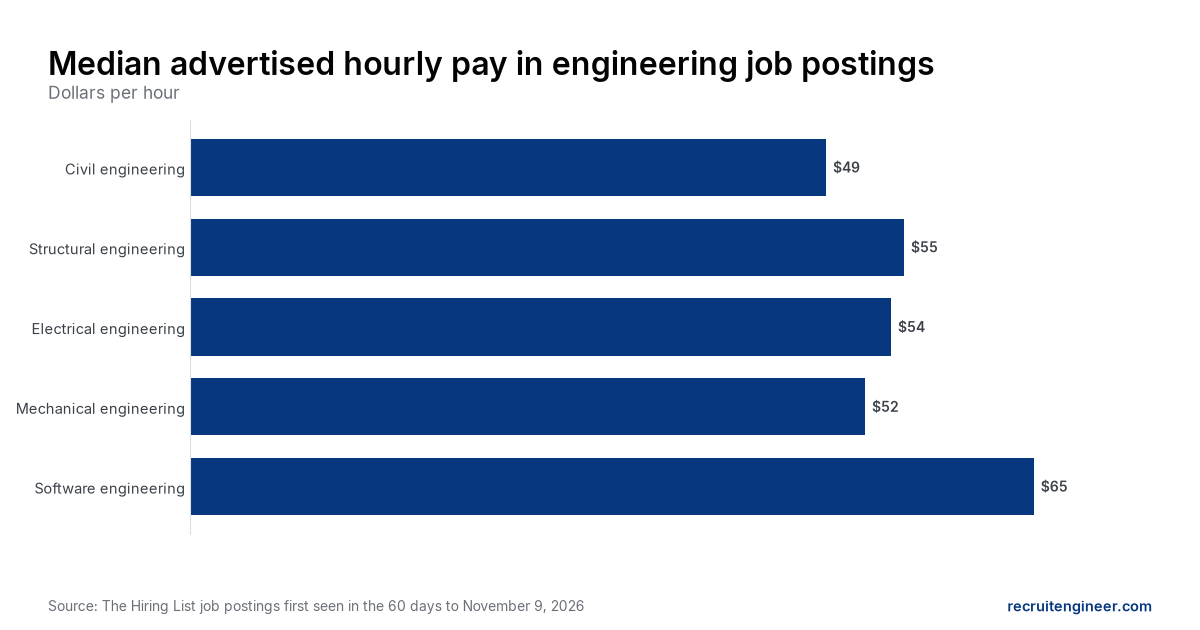
Our analysis of engineering job postings that listed hourly pay, collected by The Hiring List and first seen in the 60 days to November 9, 2026, gives a sense of what engineers are being offered.
| Discipline | Postings with hourly pay | 25th percentile | Median | 75th percentile |
|---|---|---|---|---|
| Civil engineering | 265 | $38 | $49 | $55 |
| Structural engineering | 219 | $40 | $55 | $70 |
| Electrical engineering | 768 | $42 | $54 | $68 |
| Mechanical engineering | 542 | $42 | $52 | $68 |
| Software engineering | 426 | $57 | $65 | $75 |
These are the hourly rates printed in the postings, so they are what the engineer is offered. If you hire through a staffing firm, its fee comes on top of that. Software is the priciest discipline per hour in the group, which is a little funny given that speculative product work is the first thing a downturn plan tells you to pause. For the funded civil and electrical work you are keeping, a contractor at a typical hourly rate can carry a peak and then go home.
Keep the campus pipeline open, even if smaller
Campus hiring is where that first statistic comes back. If most civil engineering openings come from people leaving, then the juniors you skip in a slow year are the mid-level engineers you are short of a few years later, when the retirements have continued and the recession has ended. So keep showing up at career fairs and keep the internship program running, even at half the size.
Do the same with senior candidates you are not ready to hire. Tell them the role is tied to a project that has not been funded yet and tell them when you expect to know. Then call them when you do.
Never rescind an accepted offer
An engineer who has accepted your offer has probably resigned from a job already. Rescinding saves you a few months of salary that a funded project may well have covered anyway. What it costs is harder to price. Engineering is a small world within any one discipline and region, so the candidates you want next year will hear about the ones you dropped this year.
If the work behind an accepted offer disappears, there are better options. You can ask the engineer to agree to a later start date in writing. You can move them onto a funded project that needs the same skills. If you truly cannot keep the role, talk to an employment lawyer before you talk to the engineer, because the person may have quit a job on the strength of your letter.
Offers that are out but not yet accepted are a different case. If the funding is in doubt, say so before the engineer accepts so they can decide with the same information you have.
What to do this month
- List every open engineering requisition next to the project it supports and whether that project’s money is signed.
- Keep roles open where the project is funded, a license is required or the search takes months.
- Pause requisitions tied to product work that depends on next year’s forecast and tell the candidates in process.
- Price contract coverage for each peak in the funded backlog before you add permanent headcount.
- Keep the internship program and campus visits going at a smaller scale.
- Honor every offer that has already been accepted.
If the top of your list is a funded civil program with a PE seat open, that is the search to start this week, whether you run it yourself or with specialist civil engineering recruiters.