How much does a recruiter cost to hire an engineer?
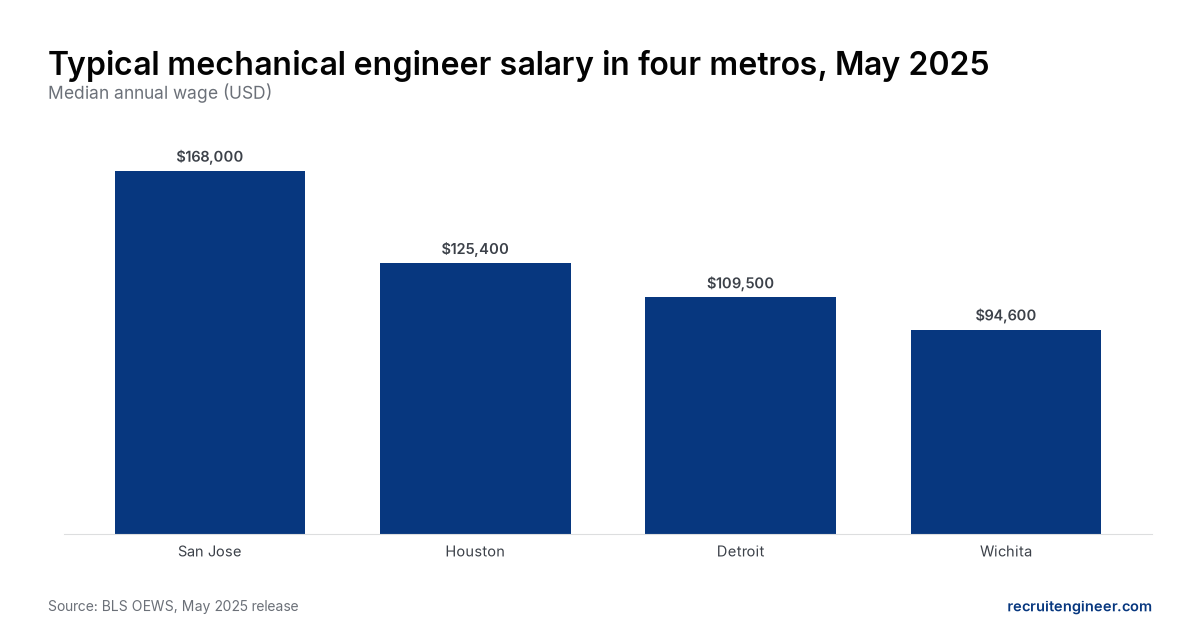
A recruiter who fills a mechanical engineering job in San Jose gets paid more than one who fills the same job in Wichita. At a 20 percent fee the gap comes to about $14,700. The work is more or less the same. But the fee is a share of first-year pay and San Jose pays mechanical engineers far more, which is a strange way to price a service.
Ask how much does a recruiter cost and the answer comes in three shapes, depending on the deal you sign. In a contingency search you pay only if you hire someone the recruiter found. In a retained search you pay part of the fee up front, whether or not the job gets filled. With a contract engineer you pay by the hour for as long as the person works for you. The first two are priced off salary, as Colorado State University’s procurement guidance on search firms describes them. The third is priced off an hourly rate.
Contingency means you pay if it works
A contingency recruiter works for free until the day you hire one of their candidates. Then you owe them a percentage of that person’s first-year pay, which can run from 20 to 35 percent of base salary or total pay. That range looks high until you think about it from the recruiter’s side. They might be working your search alongside several others and lose some of them to your own job ad or to another agency. They earn nothing on those, so the fee on the search they win is also paying for the ones they lost.
The word to watch in all of that is pay. Base salary is one number. Base plus a signing bonus plus a target bonus is a bigger one and the fee grows with it. So before you sign, write down exactly which pieces of compensation the percentage applies to. It costs nothing to settle that early and it can get awkward once an offer is on the table.
Retained means you pay either way
A retained search firm takes part of its fee before it has found anyone. Colorado State’s guidance describes an up-front fee paid whether or not the position is filled. The firm hired for a University of Utah presidential search wrote that its fees are typically based on one-third of total first-year cash compensation plus bonus and are not contingent on placing a candidate. Retained firms often collect the fee in three stages as the search moves along.
University searches show the same pattern. Reporting on the University of Minnesota found that search firms typically charge one-third of the candidate’s estimated salary and run a replacement search at no cost if the hire leaves or is fired within the first year. That replacement promise is worth asking for in any deal you sign, retained or not.
Paying before you see a candidate sounds like a bad trade, but it buys something. The firm is committed to your search rather than to whichever search looks likeliest to pay out this month. For a senior engineering manager or a rare specialist, that commitment can be worth the money. For a mid-level mechanical engineer it is probably more machinery than the job needs.
The fee on a mechanical engineer’s salary
Because the fee scales with pay, it helps to see it on real salaries. The salaries here are the typical pay for mechanical engineers in four metros, from federal wage data for May 2025. The first fee column applies 20 percent, which is the bottom of the contingency range. The second applies one-third, the retained figure. Both fees are rounded to the nearest hundred dollars.
| Metro | Typical mechanical engineer salary | Fee at 20 percent | Fee at one-third |
|---|---|---|---|
| San Jose metro | $168,000 | $33,600 | $56,000 |
| Houston metro | $125,400 | $25,100 | $41,800 |
| Detroit metro | $109,500 | $21,900 | $36,500 |
| Wichita metro | $94,600 | $18,900 | $31,500 |
Say you are hiring a mechanical engineer in Houston and trying to choose between the two deals. At these rates the retained version costs $16,700 more than the contingency one. You also pay part of it before you have met a single candidate, which is fine if you need the commitment and expensive if you do not.
The other thing worth noticing is that a recruiter’s fee is mostly a fact about the local labor market. An employer paying a San Jose salary pays a San Jose fee, even if the search took a week. The price follows the salary rather than the effort. If you are hiring in a high-pay metro and the role is one you could plausibly fill yourself, the percentage deserves a harder look.
The recruiter would like the engineer to be paid more
Follow the percentage one step further. If the fee is a share of salary, every extra dollar you agree to pay the engineer is also a fraction of a dollar for the recruiter. A researcher quoted by Inside Higher Ed said that firms paid on first-year salary benefit from helping negotiate the highest base salary possible. That does not make your recruiter your opponent. A contingency recruiter who loses the offer gets nothing at all. A bit more salary moves their fee by only a fifth of that bit at the bottom of the range, so their stronger interest is in the offer getting signed.
Still, it is worth knowing whose side of the table the arithmetic sits on. If the recruiter is relaying salary expectations from a candidate, you might ask the candidate directly as well.
Contract engineers are priced by the hour
Contract work runs on a different deal, priced by the hour rather than off a salary. For a sense of what an engineer earns per hour, look at what employers advertise. Our analysis covers about 540 hourly mechanical engineering job postings that listed pay, collected by The Hiring List and first seen in the 60 days to November 9, 2026. The typical one advertised $52 an hour.
Whatever an agency charges on top of that rate is not all profit, because whoever employs the engineer also carries the payroll costs that come with an employee. In federal employer cost data for June 2026, wages were 70.0 percent of what private employers spent on compensation. Benefits made up the other 30.0 percent. So when you compare a contractor’s hourly rate with a salary, compare it with the salary plus everything else you would spend on an employee.
Which deal to pick
If you could probably fill the job yourself with a decent ad and some patience, contingency is the cheap option, because you only pay for an outcome you would have reached more slowly anyway. If the role is senior or rare and you need someone working the search from start to finish, retained makes sense. In that case the fee being paid either way is the point of the arrangement. If you need a mechanical engineer on a project for six months and are not sure about the year after, contract keeps that decision open.
Whichever deal you pick, start from the salary, since every one of these fees is built on it. The engineering hiring value tool compares what a discipline pays from one city to another. If a mechanical search is what you are about to run, the mechanical engineering practice page sets out the roles and screening involved.