How to build a talent pipeline for the engineers you will need next year
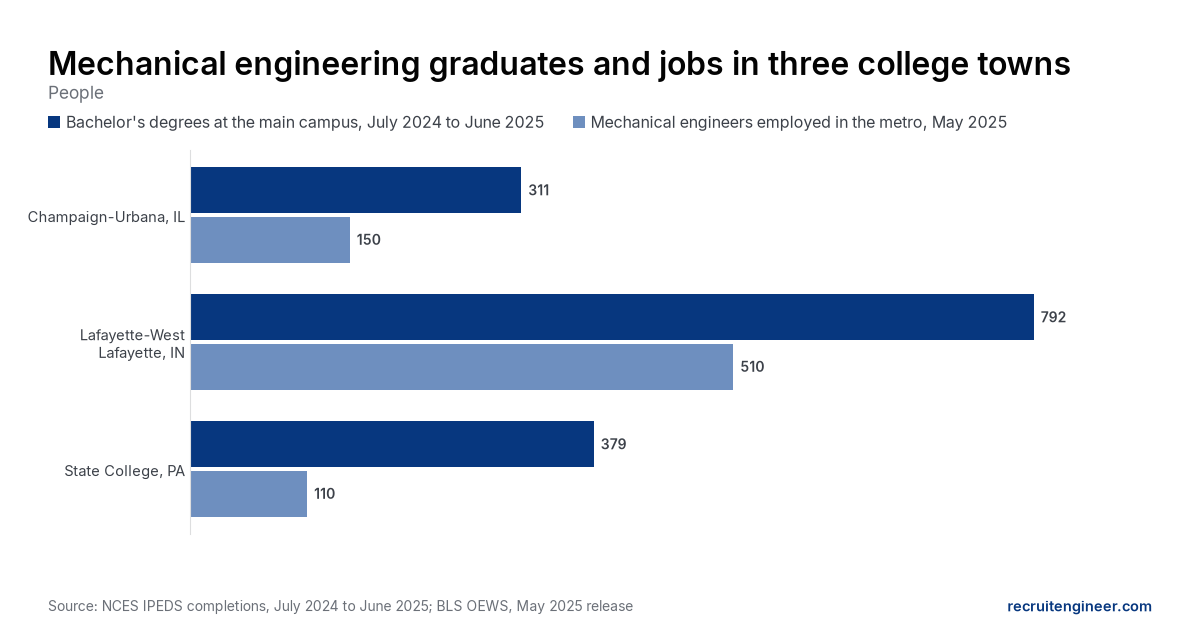
Purdue University’s main campus handed out 792 bachelor’s degrees in mechanical engineering in a single school year. The metro around it, Lafayette and West Lafayette in Indiana, employs about 510 mechanical engineers in total, so one graduating class could fill every mechanical engineering job in town and still have a few hundred people left over.
Both facts are true at once, and they stop being strange as soon as you remember that new engineers move. If you are working out how to build a talent pipeline for the engineers you will need next year, that is roughly the whole idea. Some college towns make far more engineers each spring than they could ever employ, so those graduates go to whoever asked them early enough. A pipeline is a way of being the employer that asked, before the job was open, so that when it opens there are already people who know who you are.
Engineers come from a few towns and then leave them
Put Purdue next to two other big engineering schools that sit in small metros. Each row puts one year of bachelor’s degrees from the main campus against every engineer of that kind working in the surrounding metro, at any age or level.
| University | Metro | Civil engineering bachelor’s degrees | Civil engineers employed | Mechanical engineering bachelor’s degrees | Mechanical engineers employed |
|---|---|---|---|---|---|
| University of Illinois Urbana-Champaign | Champaign-Urbana, IL | 173 | 230 | 311 | 150 |
| Purdue University-Main Campus | Lafayette-West Lafayette, IN | 216 | 90 | 792 | 510 |
| Pennsylvania State University-Main Campus | State College, PA | 190 | 160 | 379 | 110 |
The degree counts are federal college completions data for July 2024 to June 2025 from IPEDS. The job counts are federal wage and employment data for May 2025.
In all three metros, one campus’s mechanical engineering class is larger than the whole local population of mechanical engineers. Civil is close behind, since two of the three schools graduate more civil engineers in a year than their metros employ. Those graduates cannot all stay, so a large share of every class goes to work somewhere else.
That is the useful part if you are hiring in Houston or Phoenix or anywhere that is not a college town. You are not really competing with the employers in Champaign for those graduates, because there are not enough of those employers to absorb them. You are competing with every other company that thought to show up. You can look up degree counts for other metros and disciplines with the engineering graduate pipeline tool and pick the two or three campuses worth your time.
Go to campus before you have a job open
Showing up mostly means being known to students a year or two before they graduate. A career fair booth is the minimum version. Sponsoring a senior design project is better, because a small team of students spends a semester on a problem from your company and your engineers get to watch how each of them works. Speaking at the student chapter of the professional society for your discipline is cheaper still, and it reaches people who chose to spend an evening on engineering.
The point of all of it is to get names before the hiring season starts. If your company only goes to campus when it has an opening, you may be meeting seniors in the spring who already accepted offers in the fall. If the school runs a co-op program, a student can work for you for a full term while still enrolled, which is a much longer look than a summer.
One small thing worth asking any engineering student about is the FE exam. NCEES says the Fundamentals of Engineering exam is designed for recent graduates and students close to finishing an undergraduate engineering degree, and that it is generally the first step toward a professional engineering license. A student who takes it before graduating has told you they mean to get licensed, which is worth knowing if you are hiring for the long run.
An internship is a long job interview
The cheapest way to hire a graduate is to have employed them already. The National Association of Colleges and Employers found that employers converted 63.1% of their 2024-25 interns into full-time hires, according to its 2026 internship and co-op survey.
The retention figures from the same report matter more. More than three-quarters of new hires who had interned with the employer were still there after a year, while less than half of hires with no internship were, according to NACE’s look at internship program retention. So an internship works sort of like an option. You pay a student for a summer and find out whether they are good. If they are, you get the first chance to hire them, before they ever meet the rest of the market.
Hiring a graduate costs less, at first
The other reason to bother is pay. Our analysis of engineering job postings that listed pay, collected by The Hiring List and first seen in the 60 days to November 9, 2026, shows entry-level roles advertising noticeably less than mid-level ones in the same discipline.
| Discipline | Entry-level postings | Entry-level median advertised pay | Mid-level postings | Mid-level median advertised pay | Difference |
|---|---|---|---|---|---|
| Civil engineering | 383 | $80,000 | 1,407 | $107,500 | $27,500 |
| Mechanical engineering | 541 | $84,500 | 2,580 | $112,500 | $28,000 |
Say you need a civil engineer three years from now. You could wait and hire one at mid-level, or you could hire a graduate next summer and start them at roughly $27,500 less in advertised pay while they grow into the job. That is not free. A new graduate needs supervision and a senior engineer’s time, and some of them leave anyway. But it means the engineer you need in three years is, with any luck, someone who already works for you and already knows your drawings.
Keep the people who came second
Every search that ends in a hire also produces a candidate or two who were good enough and lost narrowly. They are sometimes called silver medalists. They have already been screened and interviewed by your engineers, and they already know what your company does. That makes them the most finished part of any pipeline you have, and also the easiest part to lose track of.
Keeping them costs very little. Tell the runner-up plainly that they were close and ask whether you can call them when the next role opens. Then write down why they lost. Sometimes the reason was the role rather than the engineer, which means the next opening may suit them better. When it comes, call them before you post the job. They may ask for more than last time, and paying a little more for a finalist your engineers already liked is usually quicker than starting a new search.
Ask your engineers who they went to school with
Your own engineers are a pipeline too. A mechanical engineer who came out of Purdue graduated alongside several hundred others in the same major, and the classmates from a few years back are now working somewhere as experienced engineers. Your engineers know which of those classmates were good, which is information a job board does not have.
A referral bonus helps people remember to ask. The more useful habit is asking a specific question. Ask which classmate they would want on this project, rather than whether they know anyone looking for a job, because the best answer to the first question is often someone who is not looking.
What to do this month
- Count the engineers you expect to need next year by discipline and level, since an entry-level civil engineer and a senior one come from different places.
- Pick two or three campuses that graduate a lot of engineers in those disciplines and get in front of their students this academic year.
- Open intern or co-op roles early enough to fill them for next summer, before the students you want accept somewhere else.
- Keep a short list of finalists from every search and call them first when a similar role opens.
- Ask each engineer on your team for the name of one classmate worth hiring.
If the gap you can see coming is civil engineers, the schools that graduate more civil engineers than their towns can hold are the ones to visit first, because their students already expect to move. For a role that cannot wait for next spring’s class, the civil engineering recruiting practice is the place to start the search.