Mechanical engineer salary: what employers are paying, from their own job postings
So what is a mechanical engineer salary right now? If you go by what employers are advertising, the typical mechanical engineering job posted in the US this fall pays $124,000 a year in base salary. That figure puts a new graduate and an engineering manager in the same pile, though, so it is worth pulling apart before you quote it to anyone.
The source is our analysis of about 53,200 engineering job postings that listed pay, collected by The Hiring List and first seen in the 60 days to November 9, 2026. Of those, about 5,700 were for mechanical engineers. Each posting counts once, at the midpoint of the base pay range it advertised, so a range counts as the number halfway between its two ends.
Start with the word in front of the title
The postings sort into three levels by their titles. Entry level means junior, associate, entry level or level I titles. Senior means senior, lead, principal, staff or level III and above, plus engineering managers. Mid level is every title with no level word at all, which is a slightly funny category, because it is defined by the employer declining to say.
| Level | Postings | Median advertised pay | Middle half |
|---|---|---|---|
| All levels | 5,737 | $124,000 | $100,000 to $149,200 |
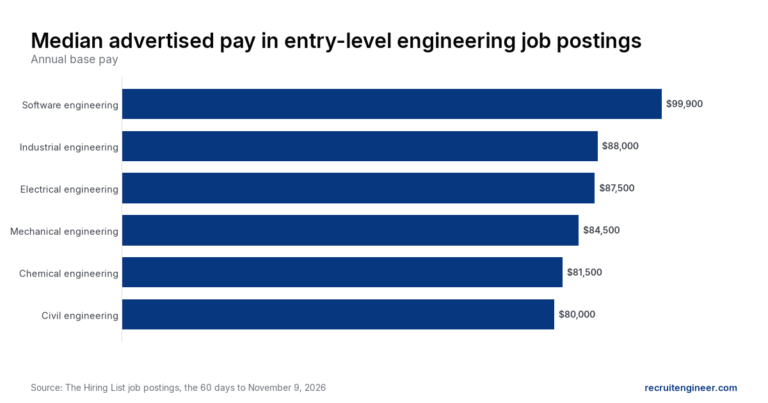
| Entry | 541 | $84,500 | $77,500 to $95,000 |
| Mid | 2,580 | $112,500 | $95,000 to $132,500 |
| Senior | 2,616 | $142,400 | $122,700 to $162,500 |
The middle half runs from the posting a quarter of the way up the pay scale to the one three quarters of the way up, so half of all postings at that level land inside it. The median senior posting pays $57,900 more than the median entry-level one. That is roughly what the market pays for the word senior, though the word is really standing in for years of work.
The edges are more useful than the middles. The top quarter of entry-level postings starts at $95,000, which is exactly where the bottom quarter of mid-level postings tops out. The cheapest quarter of senior postings tops out at $122,700 while the best-paid quarter of mid-level postings starts at $132,500. So some mid-level jobs pay more than some senior jobs, which is worth knowing before you hold out for a title.
New Mexico outpays California, at least in postings
Pay by state is noisier, because some states have only a few dozen postings and a handful of employers hiring at once can move the median. Only states with at least 30 mechanical engineering postings get a figure. Washington, DC is treated as a state here.
The six with the highest advertised pay
| State | Postings | Median advertised pay | Middle half |
|---|---|---|---|
| New Mexico | 46 | $151,100 | $133,800 to $176,600 |
| California | 492 | $147,500 | $122,300 to $172,600 |
| Washington, DC | 39 | $135,500 | $107,100 to $162,500 |
| Washington | 95 | $134,000 | $115,500 to $170,000 |
| Alabama | 75 | $133,700 | $118,300 to $151,500 |
| Massachusetts | 121 | $131,000 | $108,600 to $149,600 |
New Mexico at the top on fewer than 50 postings is the sort of result you should hold loosely, because one employer hiring heavily could put it there. California is the sturdier finding. It has about 490 postings, more than any other state. Its median still sits near the top.
The six with the lowest advertised pay
| State | Postings | Median advertised pay | Middle half |
|---|---|---|---|
| Wisconsin | 61 | $112,500 | $87,500 to $129,600 |
| South Carolina | 36 | $108,300 | $92,900 to $135,000 |
| Minnesota | 48 | $106,600 | $86,100 to $122,900 |
| Oklahoma | 35 | $106,200 | $80,000 to $125,000 |
| Indiana | 64 | $104,300 | $79,600 to $129,400 |
| Ohio | 142 | $97,500 | $87,400 to $125,500 |
Ohio is the only state in the data where the typical posting comes in under $100,000. It gets there on about 140 postings, which is too many to wave away as noise.
It is also worth asking why some states show up at all. A posting only enters the data if it states a salary. Some states make that compulsory: in Washington, for example, employers with 15 or more employees must include a wage scale or salary range in a job posting. So the number of postings from a state measures partly how much it is hiring and partly whether its law makes employers write the number down.
Federal wage data gives a different answer
The other figure people quote comes from federal wage data for May 2025, which reports what mechanical engineers in each metro area earned. The survey behind it counts full-time and part-time workers paid a wage or salary but leaves out the self-employed. According to the survey’s own definitions, its wages are straight-time gross pay that exclude year-end bonuses, stock, profit sharing and overtime.
So the two sources are measuring different things, in a few specific ways:
- The federal figure covers everyone already in the job, including engineers hired years ago, while a posting is the price for someone hired now.
- The postings are more than a year newer than the federal survey.
- Postings lean senior, with about 2,600 senior postings against about 540 entry-level ones, while the federal median counts every worker once whatever their level.
- A posted figure is the middle of a range, and the person hired can land anywhere inside it.
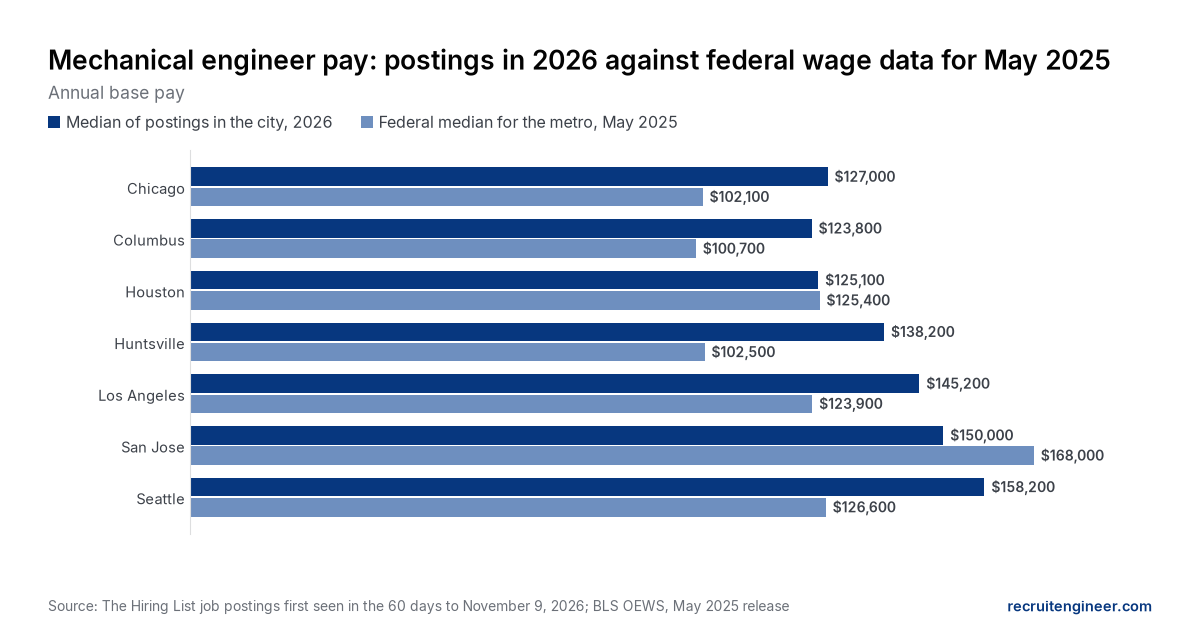
| City | Postings in the city | Posted median | Federal median for the metro, May 2025 | Posted minus federal |
|---|---|---|---|---|
| Chicago | 89 | $127,000 | $102,100 | $24,900 |
| Columbus | 44 | $123,800 | $100,700 | $23,100 |
| Houston | 37 | $125,100 | $125,400 | minus $300 |
| Huntsville | 68 | $138,200 | $102,500 | $35,700 |
| Los Angeles | 59 | $145,200 | $123,900 | $21,300 |
| San Jose | 32 | $150,000 | $168,000 | minus $18,000 |
| Seattle | 38 | $158,200 | $126,600 | $31,600 |
Houston is the tidy case, with the postings in the city and the federal figure for the metro a few hundred dollars apart. Everywhere else on the list the postings run higher by more than $20,000, except San Jose, where they run lower.
You could tell a story about each city. Huntsville’s gap of $35,700 might mean whoever is hiring there right now pays well above what the existing workforce earns. It might also just mean that 68 postings is a small sample. San Jose runs the other way. With only 32 postings set against a federal count of about 5,500 mechanical engineers in the metro, the federal number is probably the one to trust there. In five of these seven cities the price of a new hire has run well ahead of what the people already doing the job earned in May 2025.
What to ask for
If you are a mechanical engineer pricing yourself, start with the posted figures, because they are what employers are offering for the job you would actually be taking. Find your level first and your state second. The level figures are national while the state figures mix every level together, so you will be triangulating a little whatever you do.
Then aim above the median. The median is the posting with half the others below it, which is a fine place to land and a poor place to open a negotiation. If you have the specific thing a posting asks for, ask for something near the top of the middle half for your level. An offer under the bottom of that range means you are being priced like the cheapest quarter of the market, which you can say out loud, politely.
The federal numbers are useful in a different way. If your current salary sits near the federal median for your metro and postings for your level run well above it, the cheapest way to get a raise may be, in a narrow sense, to apply for your own job at another company. Before you accept a number, ask where in the posted range it falls and why, because the midpoint is only the middle of what the employer said it might pay.
What to post if you are hiring one
If you are writing the posting, the same figures work in reverse. Engineers can read every other posting in your state too, so a range is a public statement about where you sit in the market. A mid-level range centered well below $95,000 puts you in the cheapest quarter of what other employers advertise for that level, which you should expect to make the search slower. A senior range with its midpoint inside the senior middle half reads as a serious offer, and one below it reads as a mid-level job with a nicer title.
Write the range before you write the description, because a range you cannot defend is much easier to fix before anyone has seen it. If you would rather hand the search over, our mechanical engineering recruiting page is the place to start.
If you are the engineer, the next step is smaller. Pull up five current postings at your level in your state, write down the midpoint of each range and see where your own salary falls among them.