Entry-level engineering salaries by discipline and city
If you are about to take your first engineering job, settle on the city before you judge the offer, because an entry level engineering salary depends on where the desk is about as much as on what your degree says. Two civil engineers with the same transcript can start a long way apart. Discipline still matters too, and it matters in a fairly predictable order.
First you need a number that stands for a new engineer. The federal wage survey reports pay for each occupation in each metro area as percentiles, which the Bureau of Labor Statistics defines as boundaries between the lower-paid and higher-paid workers in a job. The 25th percentile is the line that a quarter of the engineers in that job and place sit below. A new graduate starts near the bottom of the ladder, so a point a quarter of the way up is a reasonable stand-in for a first offer. It is an estimate rather than a record of anyone’s first paycheck. The figures come from federal wage data for May 2025, published in the occupational employment and wage tables.
Starting pay by discipline in four big metros
Start with four big metros outside California: Chicago, Dallas-Fort Worth, Houston and Washington.
| Discipline | Chicago | Dallas-Fort Worth | Houston | Washington |
|---|---|---|---|---|
| Aerospace engineers | $104,400 | $107,700 | $102,000 | $132,500 |
| Biomedical engineers | $69,600 | $75,000 | $73,600 | $96,700 |
| Chemical engineers | $94,200 | $105,100 | $126,300 | $97,800 |
| Civil engineers | $80,000 | $77,700 | $80,000 | $84,600 |
| Electrical engineers | $92,300 | $89,400 | $96,000 | $98,600 |
| Industrial engineers | $82,300 | $93,000 | $92,700 | $98,400 |
| Mechanical engineers | $83,100 | $87,200 | $99,100 | $100,800 |
| Software developers | $104,500 | $105,700 | $101,200 | $123,700 |
The order holds up well across all four. Aerospace and software sit in the top three in every one of them. Civil and biomedical are the bottom two in every one of them. So if you are still choosing a major, the federal data has a mild opinion. If you have already chosen civil, its opinion is that you start a bit behind: in Chicago a new civil engineer starts $24,500 below a new software developer.
The odd number is chemical engineering in Houston, which starts $24,300 ahead of aerospace, the next discipline there. That is probably less about new chemical engineers in Houston than about who the other chemical engineers in Houston are. A percentile describes everyone in the job, so if a metro’s chemical engineers are mostly experienced plant people, a quarter of the way up their ladder sits well above where a graduate would start. Chemical engineering job ads with junior titles advertise a median of $81,500, which points the same way.
What entry-level job postings advertise
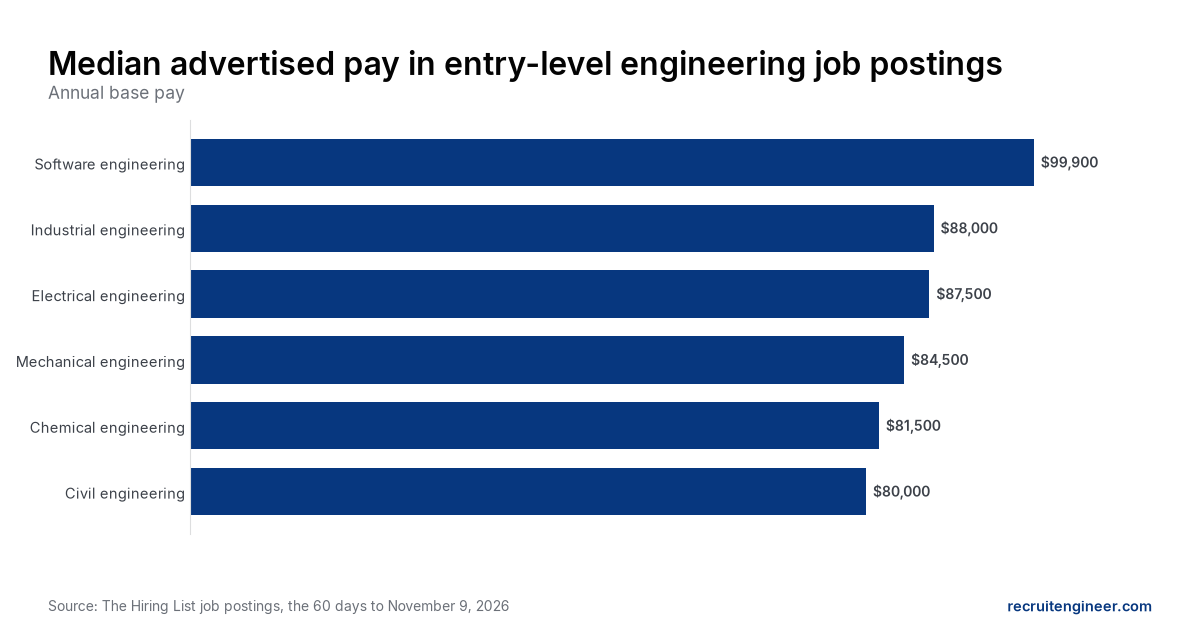
The other way to find a starting salary is to read what employers put in ads for junior jobs. In our analysis of 49,100 engineering job postings that listed pay, collected by The Hiring List and first seen in the 60 days to November 9, 2026, some carried junior, associate, entry level or level I titles. These are the medians of the base pay those ads offered.
| Discipline | Median advertised base pay | Entry-level postings |
|---|---|---|
| Software engineering | $99,900 | 257 |
| Industrial engineering | $88,000 | 61 |
| Electrical engineering | $87,500 | 595 |
| Mechanical engineering | $84,500 | 541 |
| Chemical engineering | $81,500 | 154 |
| Civil engineering | $80,000 | 383 |
The order is close to the federal one, with software on top and civil at the bottom. The spread is narrower, since electrical beats civil by only $7,500. Industrial comes second on only about 60 postings, so do not lean on it. And civil postings advertise a median of exactly the $80,000 that civil engineers in Chicago and Houston earn at the 25th percentile. That is a coincidence, though it does suggest the stand-in is not wildly off.
Where new engineers start highest
Here are civil, mechanical and electrical engineering in seven more large metros, including the two in the Bay Area.
| Metro | Civil engineers | Mechanical engineers | Electrical engineers |
|---|---|---|---|
| New York | $88,700 | $92,200 | $100,600 |
| Los Angeles | $84,500 | $96,000 | $103,800 |
| Boston | $85,700 | $97,700 | $100,000 |
| San Francisco | $103,000 | $128,300 | $124,700 |
| San Jose | $100,300 | $134,500 | $157,200 |
| Seattle | $100,300 | $98,900 | $109,300 |
| Detroit | $76,300 | $98,800 | $97,800 |
For electrical engineers, San Jose is in its own category. An electrical engineer a quarter of the way up the San Jose pay ladder earns $157,200, which is $67,800 more than the same spot on the ladder in Dallas-Fort Worth. San Francisco and San Jose also start mechanical engineers higher than any other metro in either table. If you are an electrical or mechanical graduate with no attachment to a particular state, the Bay Area is where the starting number is biggest. Find out what an apartment there costs before you treat the difference as yours.
Civil pay moves less between cities, but it does move. San Francisco, San Jose and Seattle are the only metros in either table where a new civil engineer clears six figures. A civil engineer who starts in San Francisco rather than Dallas-Fort Worth starts $25,300 higher, which is more than the $24,500 between civil and software in Chicago. So for a civil engineer the choice of city is worth about as much as a change of major would have been. Moving is also a lot easier than going back to school.
Detroit pays its disciplines very differently from one another. A new mechanical engineer there starts at $98,800 while a new civil engineer starts at $76,300, the lowest civil figure in either table. The Detroit area’s big employers include General Motors and Ford Motor Company, which tells you roughly what sort of engineering the place is buying. Seattle is the reverse case, the one metro in either table where civil starts a little above mechanical.
What to do with your first offer
Look up your discipline in the metro where the offer is. If the offer is below the 25th percentile for that job in that place, then at least three quarters of the engineers doing that job there earn more than you are being offered. That is not automatically unfair for a first job, since you are new. It is still a fair thing to ask about, and the 25th percentile gives you a figure to ask with.
Keep in mind what the federal number leaves out. The Bureau of Labor Statistics counts straight-time pay and excludes overtime and year-end bonuses, so a signing bonus or an annual bonus sits on top of the comparison rather than inside it. Compare base salary with base salary.
Then think about your discipline. If you are a civil engineer, your biggest lever is the city. New civil engineering graduates start highest among these metros in San Francisco, San Jose and Seattle. If moving is on the table, civil engineering in Seattle is a sensible first search. Mechanical graduates should not rule out Detroit, where mechanical engineering starts close to Houston and Washington. Electrical graduates face the widest spread between cities of the three, from Dallas-Fort Worth at the bottom to electrical engineering in San Jose at the top, so electrical engineering is the discipline where the move matters most.
The next step is narrower than any table. Pick the one or two metros you would actually live in and look up your discipline in the engineering salary guide. Then set your ask somewhere between the 25th percentile and the median for that metro, since a new graduate with a good internship is not obviously a bottom-quarter engineer.