Contract vs direct hire for engineers, and the contract-to-hire option in between
Should an engineering role be contract, contract-to-hire or direct hire? Pick contract when the work stops on a date you can name, contract-to-hire when you do not know whether the job will exist in a year and direct hire when the person will own the design or seal it. The rest of contract vs direct hire is cost and paperwork.
Three ways to get the same engineer
The three arrangements can put the same person at the same desk doing the same work. What changes is who employs them, who can end the arrangement and what it costs to end it. A contract engineer is employed by a staffing firm or by their own business, and you pay an hourly bill rate for their time. A direct hire is on your payroll from the first day. Contract-to-hire is a contract with an option attached, because you can move the engineer onto your payroll later on terms the staffing agreement sets out.
| Arrangement | Who employs the engineer | How it ends | Where it fits |
|---|---|---|---|
| Contract | A staffing firm, or the engineer’s own business | At the end date or on the notice the contract allows | A project with a defined scope and an end |
| Contract-to-hire | The staffing firm until conversion, then you | Conversion to your payroll, or the contract simply lapses | A role you think you need but cannot yet justify |
| Direct hire | You | The way any job ends | Ongoing work, licensed responsibility and deep product knowledge |
A project with an end date wants a contract
Say you need a mechanical engineer for eight months to carry a production line redesign through commissioning. After that the line runs and the work is done. If you hire that person directly you will either invent new work for them or let them go. Both of those cost something, in money or in morale or in your reputation with the next candidate. A contract prices the ending in at the start, so the hourly rate is partly a fee for being allowed to stop.
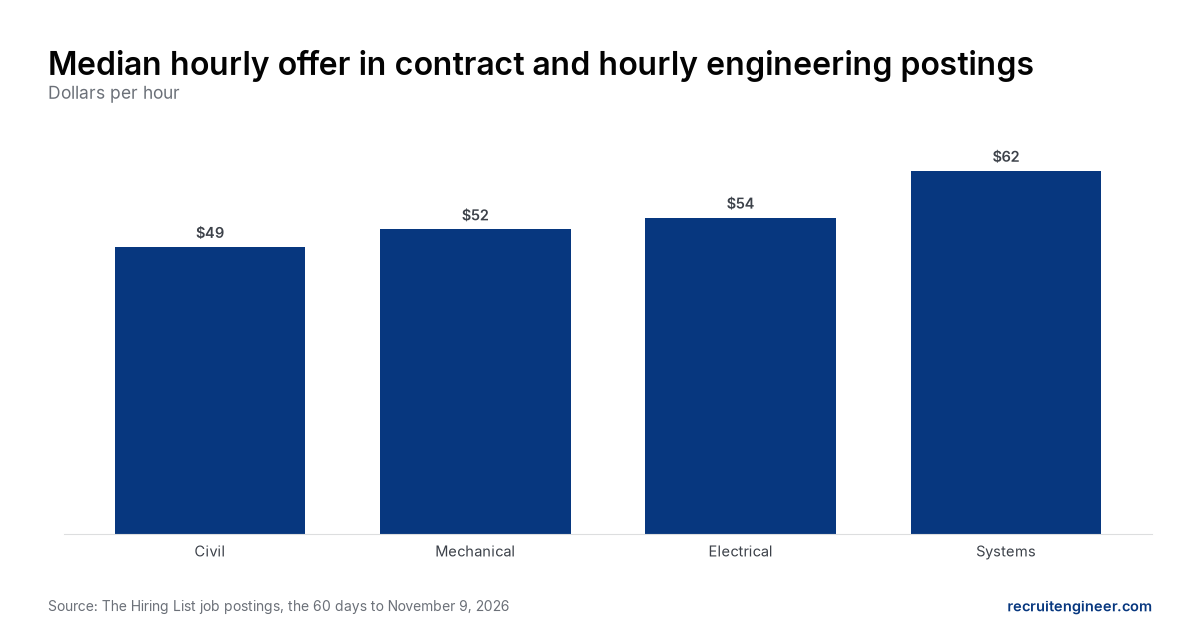
It helps to know what engineers are offered by the hour. Our analysis of engineering job postings that listed pay, collected by The Hiring List and first seen in the 60 days to November 9, 2026, gives these typical offers for contract and hourly postings next to salaried ones.
| Discipline | Contract and hourly postings, median offer per hour | Salaried postings, median offer per year |
|---|---|---|
| Civil engineering | $49 | $115,000 |
| Mechanical engineering | $52 | $124,000 |
| Electrical engineering | $54 | $126,400 |
| Systems engineering | $62 | $140,000 |
Those hourly figures are what the engineer is offered, which is not what you pay. When a staffing firm employs the contractor, its own costs and margin sit on top as the bill rate. Multiply the civil hourly figure by a full year of 40-hour weeks with no time off and the engineer grosses roughly $101,900. That is less than the salaried figure, and whatever benefits the contractor gets come from the staffing firm or from their own pocket.
What a salaried engineer really costs
The salary is only part of what an employee costs you. In the federal release on employer compensation costs for June 2026, benefits made up 30.0 percent of what private employers spent per hour on their workers. That covers all private industry rather than engineers specifically, but it gives you the right shape. A salaried hire comes with a benefits load on top of the salary, plus the cost of searching for them and the cost of parting ways if the work dries up.
So the fair comparison is the contractor’s full bill rate against the salary plus your benefits load plus the expected cost of the ending. For short work the contract wins easily, because the ending is certain and you would pay for it either way. For long work the bill rate keeps running every hour for years while a salaried engineer gets cheaper per useful hour as they learn your product. Somewhere in between the two lines cross, and where depends on your own benefits costs and the rate you negotiate.
A role you are not sure you need
Contract-to-hire is for the case where the work is real today but you cannot promise it next year. Maybe a big customer contract could still be won or lost. Maybe you are testing whether a new product line needs a dedicated test engineer at all. You get a few months of the engineer doing the actual job, which tells you far more than any interview, and you keep the option to walk away.
The price of that option is the conversion fee in the staffing agreement, which is whatever you and the staffing firm agreed to. Before the engineer starts, read that clause for a few things:
- How the fee is calculated, whether as a flat amount or as a share of the first-year salary
- Whether the fee shrinks the longer the engineer has worked on contract
- Whether there is a point after which you can convert the engineer for nothing
- Whether the fee still applies if the contract ends and you hire the engineer directly a few months later
The engineer is also making a choice. From their side, contract-to-hire is a job offer with a trial period and fewer guarantees. An engineer holding a direct offer elsewhere may simply take that one. If you want strong candidates to accept, write the target conversion date and the salary you would convert at into the offer, so they are betting on something specific.
The engineer of record should usually be yours
Licensed work changes the reasoning. The engineer who seals drawings has to be in responsible charge of them, which NSPE’s position statement on responsible charge describes using the NCEES model law definition: direct control and personal supervision of the engineering work. The same statement says that reviewing drawings after they were prepared, without involvement in the design, does not count.
So a contract PE brought in at the end of a job to stamp someone else’s drawings is the one arrangement that does not work at all. A contract PE who leads the design from the start can work, because they really are in control of it. But if your firm does civil engineering work where sealed plans are the product, the person who seals them carries your projects and your name with permitting offices. That person should probably be on your payroll, and a contract arrangement is better used for the designers and analysts who work under them.
Co-employment is about control, not labels
Co-employment means two businesses can both count as the employer of one worker. The EEOC’s guidance on contingent workers placed by staffing firms says a staffing firm and its client are both employers when both have the right to control the worker, and that a client of a temporary agency typically qualifies as an employer of the temporary worker. The client is then liable for discrimination against that worker on the same basis as for its own staff.
The useful conclusion is that you cannot contract your way out of being an employer. If your managers set the contractor’s hours, assign the work and supply the desk and the software licenses, you have most of the control that matters. That arrangement is perfectly fine. Treat contractors the way you would want an employer treated in a dispute, and keep their conditions consistent with your own policies.
Independent contractors paid directly on a 1099 are a different risk. The IRS guidance on independent contractors and employees looks at the whole relationship and the right to direct and control how the work is done. For employees the payer withholds income tax and pays the employer share of Social Security and Medicare plus unemployment tax, while for independent contractors it generally does not. An engineer who works your hours, on your equipment, on your core product, indefinitely, starts to look like an employee whatever the agreement says. If you want that kind of day-to-day control, hire through a staffing firm that employs the engineer or hire them yourself.
What to do with your open role
Write down the date the work ends. If you can, and it is within a year or so, run a contract. If you cannot, ask whether the doubt is about the work or about the person. Doubt about the work points to contract-to-hire with the conversion terms settled in advance. Doubt about the person is what interviews and references are for, and contract-to-hire is an expensive substitute for them.
Then look at who will sign. Anyone who seals drawings or owns a design long term is a direct hire. For long programs such as systems engineering roles that follow a product from requirements through verification, a direct hire probably costs you less per useful hour once the engineer is past the learning curve. That is where you might start the search.