How to recruit engineers when nobody on the team is a recruiter
Fewer than one engineering job posting in five says what the job pays. This is strange because pay is roughly the first thing anyone wants to know about a job. In California it is also the law for employers with 15 or more employees. So the typical engineering posting asks a stranger to apply for a job while keeping its most important fact to itself.
If you need to recruit engineers and nobody on your team is a recruiter, that is mildly encouraging news. Many of the postings competing for an engineer’s attention have skipped the easiest step. Recruiting engineers is mostly a few chores done in the right order. You write a posting that answers the engineer’s questions and put it where engineers in that discipline already look. You decide how you will screen before the resumes arrive. Then you move quickly enough that the candidate you like is still available when you make the offer.
Write the posting first, because it does most of the recruiting
Say you run a small company that makes industrial pumps and you need a mechanical engineer. The engineer you want might well have a job already. They will read your posting on a phone during a break at that job. They will decide whether it is worth an evening of updating a resume before they reach the bottom of the page. So the posting has one task, which is to answer their questions before they have to ask them.
For an engineering role those questions are fairly specific:
- What you will actually design, build or test, named as a product or project rather than a list of virtues.
- What the job pays, written as a base salary range you would genuinely pay.
- Which tools and standards matter, such as the CAD package, the analysis software or the design codes the work follows.
- Whether the role needs a professional engineer license now or later.
- Where the work happens and how much of it is on site, in a plant or in the field.
The license line matters most for civil and structural work. Engineers are licensed by state boards. NCEES describes the usual path to a PE license as a degree from an accredited program, roughly four years of progressive experience in most states and passing both the FE and PE exams. If a junior hire will need to sit the PE exam in a few years, saying you will support that is a reason to apply. If you need someone already licensed on day one, say so plainly because it shrinks the pool and both sides should know it early.
Put a real range in it
The range is the part you might be tempted to leave out, because it feels like showing your hand. But an engineer comparing your posting with one that lists pay has to guess at yours. A guess is a perfectly good reason to scroll on to the next posting. In California the decision is made for you, since the Labor Commissioner reads the rule as covering any job that may ever be filled in California, remote jobs included. The range has to be a good faith estimate of what you reasonably expect to pay on hire.
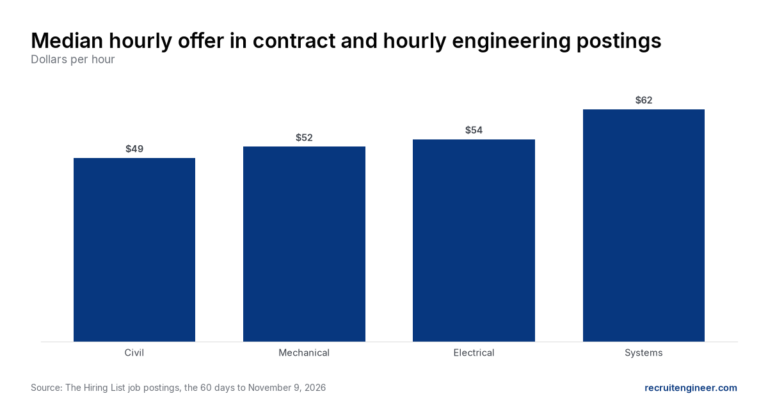
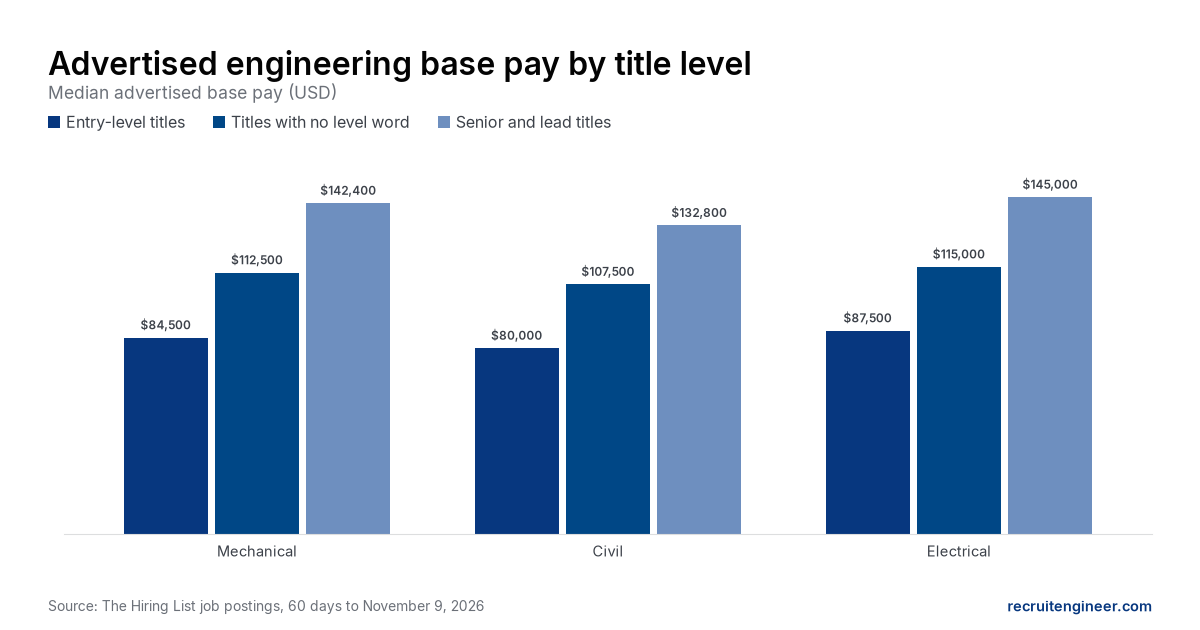
To set the range, look at what the postings that do list pay are saying. Our analysis of about 53,000 engineering job postings that listed pay, collected by The Hiring List and first seen in the 60 days to November 9, 2026, gives a useful starting point.
| Engineering job postings in the period | Count |
|---|---|
| All engineering postings first seen | 289,928 |
| Postings that listed a pay range | 53,170 |
| Discipline | Entry-level titles | Titles with no level word | Senior, lead and principal titles |
|---|---|---|---|
| Mechanical engineering | $84,500 | $112,500 | $142,400 |
| Civil engineering | $80,000 | $107,500 | $132,800 |
| Electrical engineering | $87,500 | $115,000 | $145,000 |
Each figure is the typical midpoint of the advertised base pay range, so bonus and benefits sit on top. A mechanical posting with senior in the title advertises about $57,900 more than one with junior in it. So the word you put in the job title is already a pay decision. An engineer with several years of experience may well read a title ending in I as a pay cut whatever the range says.
National figures are only a start, because local pay may sit well away from them. If you are hiring mechanical engineers or civil engineers in a particular metro, check the engineering salary guide before you settle the numbers.
Post where engineers in that discipline already look
A general job board gets you volume, which is useful and also a lot of reading. A discipline board gets you fewer applicants who are closer to the point. For civil roles, ASCE pitches its Career Connections job board to employers as a way to reach a network of over 150,000 civil engineers. It is worth asking whether the society for your own discipline offers something similar before you pay for a general listing.
If you are hiring someone experienced, the more productive channel is probably the engineers you already employ. They know people they studied with and people they used to work with, which is a list of candidates someone has already screened informally. Ask each engineer on your team for two or three names of people they would happily work with again. Then write to those people yourself with the posting and the range attached.
Direct outreach to strangers works the same way. Search professional profiles for the specific words in your posting, such as the product type or the design code. Then send a short note that says what the job is and what it pays. Given how few postings name the pay, a note that does stands out more than you might expect.
For entry-level roles, start with the career offices at engineering schools near you. You might also ask whether you can sponsor a senior design project, which works as a long and fairly relaxed interview for both sides. If you only have time for one channel, use referrals for experienced hires and the schools for new graduates. Add a discipline board once those are moving.
Decide how you will screen before anyone applies
If you are not that kind of engineer yourself, every resume in a discipline sounds roughly the same. They all mention design, analysis and cross-functional collaboration. The way out is to decide in advance what a good answer sounds like. Then ask every candidate the same question about work they personally did, which is much harder to fake than a list of skills.
| Discipline | Ask them to walk you through | Settle before you post |
|---|---|---|
| Mechanical | A design they took through analysis, prototyping and testing | The equipment, materials and loads that matter for the role |
| Civil | A project where they made design decisions and handled permitting and client coordination | The project type and whether the role needs a PE license |
| Structural | Their analysis and detailing on a comparable structure | The structure type, the materials and any license requirement |
| Electrical | Equipment they designed and how they tested or commissioned it | Whether the work is power and plant controls or electronics development |
| Manufacturing | A process they introduced or improved and what happened to yield or throughput | The product, the production volumes and the equipment |
| Software | A system they shipped and the tradeoffs they made along the way | The product, its users and the operating environment |
Have your best engineer in that discipline write the follow-up questions for each row, because they will know within a few minutes whether an answer is real. A short call between that engineer and each promising candidate early on spares everyone a full interview day with people who were never close.
Move faster than feels reasonable
The candidate you like is, more or less by definition, a candidate other employers will like. Every week between the first interview and the offer is a week in which someone else can make an offer first. Hiring processes tend to grow extra steps because each step feels free to the person adding it. It is only expensive to the candidate, who is quietly interviewing elsewhere while you schedule the next round.
- Name the one person who can say yes and put them in the final interview.
- Block interview time on the team’s calendars before the posting goes live.
- Keep the process to a screening call and one interview day if you can.
- Tell candidates the timeline on the first call and then keep to it.
- Agree the offer before the final interview so it can go out within days.
If the offer is slow because the pay needs another approval, that is a sign the range in the posting was not the real range. Fix the range rather than the approval chain.
What to do first
- Sit down with your strongest engineer in the discipline and write the screening questions.
- Write the posting with the real work, the license requirement and a base pay range.
- Send it to your own engineers for referrals on the day it goes live.
- Post it on a general board and on your discipline’s society board.
- Start writing directly to engineers whose profiles match the work.
The first step is the one that tends to get skipped, and it is the one that makes the rest go faster. If the search is for a licensed civil engineer and it stalls after a few weeks of this, our civil engineering search can pick it up from there.